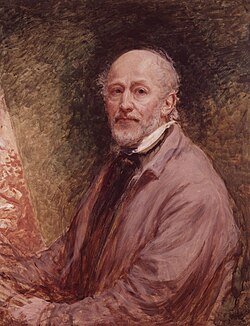
John Linnell
1792–1882 · English landscape painter, portraitist and engraver
John Linnell (Bloomsbury, London, 1792 – Redhill, Surrey, 1882) was an English engraver, portrait painter and landscape painter. He is best known for his landscapes, although he was also a rival of John Constable and a keen admirer of Northern European Renaissance art, especially Albrecht Dürer. He had a serious interest in natural history.
The son of a carver and gilder, he was drawing and selling portraits in chalk and pencil by the age of ten. His first teacher was the American-born painter Benjamin West, and he spent a year in the household of John Varley, where William Hunt and William Mulready were also pupils. In 1805 he entered the Royal Academy, winning medals for drawing, modelling and sculpture, and trained as an engraver. Around 1808 he moved into Mulready's house.
At first he earned his living through miniatures and larger portraits, including likenesses of Mulready, Richard Whately, Peel and Thomas Carlyle, several of which he engraved in line and mezzotint. He also painted religious subjects such as “St John Preaching” and “The Journey to Emmaus”, but his reputation rests on his landscapes of the English countryside, often lit by a glowing sunrise or sunset. Around 1850 he settled at Redhill, Surrey, and painted the North Downs and the Kentish Weald. In his later years he studied the Bible in its original languages and published several pamphlets on biblical criticism.
He was one of William Blake's closest friends and most generous patrons. Blake stayed with him as a guest, and Linnell commissioned from him drawings and engravings for the Book of Job and for Dante. Through Linnell, Blake also came to know Samuel Palmer, who later married Linnell's eldest daughter. His legacy lies chiefly in his landscapes and in his role as a link between Blake and the younger artists around him.
Works (2)

Portrait of Robert Peel, British politician twice prime minister, painted by John Linnell while Peel was Leader of the Opposition. Shown at the Royal Academy's 1838 Summer Exhibition, it is one of the best-known images of him. An 1840 oil-on-canvas version, kept by the Peel family, later entered the National Portrait Gallery in London.
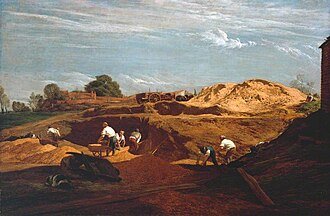
Painted by John Linnell, the picture shows workers digging gravel from pits in Kensington, a rural village on London's western edge that took its name from them. The gravel was sieved into grades for the building work of the expanding West End. Linnell lived there alongside William Mulready. Now held by Tate Britain.
Where to see the work
- National Portrait Gallery London · 1
- Tate London · 1
Teachers and pupils
Studied with
- John Varley 1778–1842
Curiosities
A patron for Blake
Linnell commissioned from William Blake two of the largest single series of designs the artist ever received: the illustrations for the Book of Job and those for Dante. He paid around £150 for each. Blake, who lived largely in poverty, found in these commissions an important source of income in his later years.
A drawing by his son
His eldest son, William Linnell (1826-1906), was also an artist and is best remembered for a drawing of 1840 called Smugglerius. It is an écorché, a figure of a man with the skin removed to show the musculature, posed in imitation of the ancient Roman sculpture known as the Dying Gaul.
A plaque in Hampstead
At Old Wyldes, North End, Hampstead, a blue plaque commemorates Linnell. The inscription notes that William Blake stayed in the house as his guest. Blue plaques are the British system for marking buildings linked to notable people, and this one identifies a site connected with the friendship between the two artists.