
John William Waterhouse
1849–1917 · British Pre-Raphaelite and Symbolist painter
John William Waterhouse RA (baptised 1849 – 1917) was an English painter who began in the Academic style of Victorian London and later embraced the Pre-Raphaelite Brotherhood's style and subject matter, while also drawing on Impressionist light in his later years. His best-known pictures show young women from ancient Greek myth, Arthurian legend and the plays of Shakespeare, painted with a soft, dreamy atmosphere that places him largely within Symbolism. He was highly successful during his lifetime, his reputation declined through the twentieth century, and his work was reassessed toward its end.
Roman birth and London childhood
Waterhouse was born in Rome to the English painters William and Isabella Waterhouse. His exact birth date is unknown: he was baptised on 6 April 1849, and the scholar Peter Trippi believed he was born between 1 and 23 January. As a child he was nicknamed Nino. The family returned to England in the 1850s and settled in a newly built house in South Kensington, near the recently founded Victoria and Albert Museum. Surrounded by art, the boy was encouraged to draw, and he often sketched works he saw in the British Museum and the National Gallery. In 1871 he entered the Royal Academy of Art schools, initially to study sculpture before turning to painting.
Early classical paintings
His first works were not Pre-Raphaelite. They were classical subjects in the manner of Alma-Tadema and Frederic Leighton, shown at the Dudley Gallery and the Society of British Artists. In 1874 his Sleep and his Half-brother Death was accepted by the Royal Academy summer exhibition, and it was a success. From then on he showed at the Academy almost every year until 1916, skipping only 1890 and 1915. His 1876 canvas After the Dance was given a prominent place in that year's show, and his pictures tended to grow larger. In this period he also tried Oriental themes, seen in a few early works and sketches of Arab models, though that interest did not last.
Marriage, honours and teaching
In 1883 he married Esther Kenworthy, the daughter of an art schoolmaster from Ealing who had shown her own flower paintings at the Royal Academy. That year the couple settled at Primrose Hill Studios, first at number 3 and later at number 6. In 1895 Waterhouse was elected a full Academician. He taught at the St John's Wood Art School, joined the St John's Wood Arts Club and served on the Royal Academy Council. The financier Alexander Henderson, who bought several of his paintings from 1903 until the artist's death, was an important patron. Waterhouse died in London on 10 February 1917.
From Greek myth to literature
His handling of paint changed little across his career, but his choice of subjects did. Around 1880 he moved away from ancient Roman scenes and turned to literary themes, with a clear debt to Greek mythology and literature. Consulting the Oracle (1884), Saint Eulalia (1885), The Magic Circle (1886) and The Lady of Shalott (1888) belong to this phase. The last of these draws on Tennyson's 1832 poem about Elaine of Astolat, who dies after looking at Lancelot. Waterhouse painted three versions of the character, in 1888, 1894 and 1916. Ophelia was another favourite. The best-known of his Ophelias shows her shortly before her death, placing flowers in her hair as she sits on a branch above a lake.
After 1900: lighter colour and enduring myths
After 1900, influenced by Impressionism, his work grew calmer and he used lighter, brighter colours. Works such as The Siren (1900), Ulysses and the Sirens (1891) and Hylas and the Nymphs (1896) reworked Greek myths in a more luminous palette. By about 1915 serious illness meant he could not complete the Ophelia series he had planned. He died two years later and was buried at Kensal Green Cemetery in London.
Reputation and legacy
Waterhouse was famous in his own lifetime, but his standing fell during the twentieth century, when critics stopped valuing narrative and decorative painting. Toward the century's end his work was studied again, and the Royal Academy staged a major retrospective in 2009. His legacy lies in images of absorbed women, often near water, which shaped the visual language of British Symbolism and the way mythological heroines were painted.
Works (59)


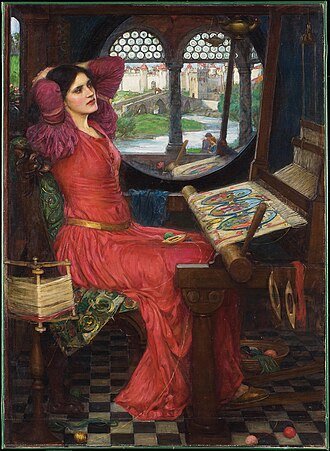




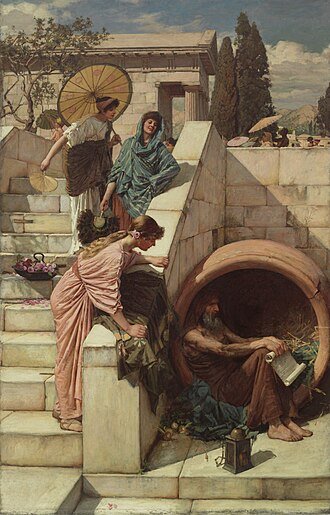


Waterhouse painted this Cleopatra in 1888, in oil on canvas, and it is associated with the Pre-Raphaelite Brotherhood. Its catalogue entry calls it a bijou, a term that suggests a small, carefully finished work, but it offers no further details about its commission, composition or reception, so any reading of its meaning should remain tentative.

This 1900 oil on canvas shows a female figure beside a desk and a book, in a space open to the sea, where a ship and a mirror can be made out. The pairing of an intimate interior with the distant sea suggests waiting or reflection, though the record offers no further detail on its specific meaning.


The Soul of the Rose is an oil on canvas by John William Waterhouse, dated 1903. It shows a young woman with dark hair and a calm face, holding a rose in a soft, dimly lit setting. The painting belongs to the orbit of the Pre-Raphaelite Brotherhood, with its interest in poetic subjects, female figures and naturalistic detail. Based only on the record, the work invites a mainly symbolic reading: the flower as an emblem of beauty and of something intimate.

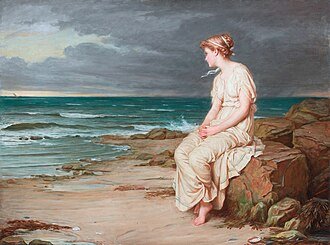
Miranda is an oil on canvas by John William Waterhouse, dated 1916, showing the young woman from Shakespeare's play The Tempest in a turbulent seascape. Dressed in light-toned clothing, she stands beside a rock while a ship caught in the storm and its shipwreck can be glimpsed in the background. The work is associated with the Pre-Raphaelite movement, to which Waterhouse is linked, and its attention to detail and to the female figure is typical of that tradition.

Painted in 1893 by John William Waterhouse in oil on canvas. Its title echoes a phrase from English Romantic literature, suggesting a narrative and melancholic subject, though the available information does not clarify the specific story depicted or the circumstances of its commission. Its traditional painterly handling is best read with caution, given the limited documentation.


John William Waterhouse painted this mythological scene in 1903, in oil on canvas, within the orbit of the Pre-Raphaelite Brotherhood. Psyche stands before a door that opens onto a garden, and a flower nearby suggests a private space reached only by crossing a threshold. The work is held by the Harris Museum.


Juliet is an oil on canvas by John William Waterhouse, dated 1898. It is a portrait of a young woman named Juliet, wearing a necklace and a dress, and it belongs to the broader tradition of the Pre-Raphaelite Brotherhood, whose interest in the female figure and careful detail is evident here. Without further reference material, it is best to describe only what the painting shows.

Mythological painting from 1908 showing Apollo with Daphne, the god's lyre serving as his identifying attribute. The scene evokes the myth's episode of sexual harassment, in which Daphne flees the god until she is transformed. The work is associated with the Pre-Raphaelite Brotherhood, whose taste for classical subjects and idealized figures is visible in its composition.

This 1906 oil painting by John William Waterhouse belongs to mythological painting and is linked to the Pre-Raphaelite Brotherhood. Its title refers to the myth of the Danaides, and the scene centres on a woman beside a large jar, an object tied to the story. The available information does not clarify its commission or reception, so any reading stays close to what the composition shows.

Waterhouse painted this scene in 1903, showing a woman beside a large vessel that recalls the Danaids, women from Greek myth condemned to fill a bottomless jar with water. The calm mood of the figure contrasts with the punishment the story describes. Without further sources, it is best to describe the work cautiously as a late mythological painting by the artist.

Portrait of a woman in a dress, titled Miss Claire Kenworthy, painted in oil on canvas. The record links it to the Pre-Raphaelite Brotherhood and dates it to 1850, a date best treated with caution. Without reference material, the commission, setting and meaning of the picture cannot be established with confidence.

Thisbe is an oil on canvas painting by John William Waterhouse, dated 1903, in the mythological genre. It depicts Thisbe, a figure from mythology, shown in a moment of listening or attention. The work is associated with the Pre-Raphaelite Brotherhood, though available information offers no further detail about its composition or commission.

Painted in 1880 and attributed to John William Waterhouse, this oil on canvas is linked to the Pre-Raphaelite circle. It shows a flower market where a woman stands among bouquets, in a setting the title places in ancient Greece. Its subject places it among mythological paintings. It is held at the Laing Art Gallery.

Painted by John William Waterhouse in 1912, this work depicts Penelope and her suitors, a scene tied to the Odyssey. Penelope appears beside her loom, with the suitors, a kithara and a flower as secondary elements. As a mythological painting linked to the Pre-Raphaelite Brotherhood, it reflects the period's taste for literary scenes from classical antiquity.

Painting by John William Waterhouse dated 1900, oil on canvas, drawing on the myth of Orpheus through a group of nymphs who find his head. The work belongs to the mythological genre associated with the Pre-Raphaelite tradition, to which Waterhouse stayed closely linked in style. No further details about its commission or reception are recorded, so it is best to confine any reading to what the scene itself shows.


A young woman gathers flowers in a garden in Devonshire, a title that places the scene in an English setting. Painted in 1893 in oil on canvas, the work focuses on the figure and the blooms around her, in line with the Pre-Raphaelite Brotherhood to which the painting is associated. The subject is a simple summer task, rendered as a quiet moment of rural life.

Oil on canvas painted by John William Waterhouse in 1905, in an upright format. The title names Phyllis and Demophoon, two figures whose names point to a story from classical antiquity, though the record does not describe the scene. Without reference texts, its commission, composition and reception cannot be specified.
Where to see the work
- Tate London · 3
- Art Gallery of South Australia Adelaide · 2
- Towneley Hall Art Gallery and Museum Burnley · 2
- Lady Lever Art Gallery Liverpool · 2
- Aberdeen Archives, Gallery and Museums collections Aberdeen City · 2
- Manchester Art Gallery Manchester · 1
- Walker Art Gallery Liverpool · 1
- Gallery Oldham Oldham · 1
- National Gallery of Victoria City of Melbourne · 1
- National Gallery London · 1
- Royal Academy of Arts London · 1
- Art Gallery of Ontario Toronto · 1
- Leighton House Royal Borough of Kensington and Chelsea · 1
- Leeds Art Gallery Leeds · 1
- Art Gallery of New South Wales Sydney · 1
- Hessian State Museum Darmstadt Darmstadt · 1
- Harris Museum Preston · 1
- Auckland Art Gallery Auckland Region · 1
- Laing Art Gallery Newcastle upon Tyne · 1
Curiosities
A painting that was not ready in time
Waterhouse wanted to submit A Mermaid to win his Royal Academy diploma, but it was not finished in time, so he sent his 1888 Ophelia instead. That canvas was lost for much of the twentieth century before resurfacing, and it now belongs to the collection of Lord Lloyd-Webber. The story shows how works submitted to the Academy could take unexpected paths.
A discovery on television
A portrait of a young woman, dated around 1875 to 1878, was completely unknown until it appeared on the BBC programme The Antiques Roadshow, where it was shown with a hole in the canvas. It was later included in Peter Trippi's monograph on Waterhouse. The case shows how works by a painter of his period can still surface from private collections.
Three versions of the Lady of Shalott
Waterhouse painted three versions of the Lady of Shalott, in 1888, 1894 and 1916. The subject comes from Alfred, Lord Tennyson's 1832 poem, in which Elaine of Astolat dies after looking directly at Lancelot. Returning to the same figure over almost three decades shows how central this literary subject was to his career.