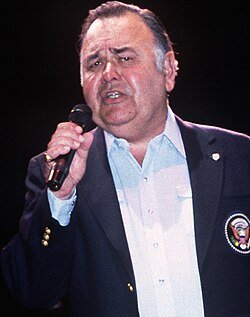
Jonathan Winters
1925–2013 · American comedian, actor and artist of postwar television and film
Jonathan Harshman Winters III (Dayton, 1925 - Montecito, 2013) was an American comedian, actor, author, television host and artist. He began as a stand-up comic and gradually moved into film and television. His humor, built on improvisation and eccentric characters, made him one of the most distinctive figures in mid-twentieth-century American comedy, and his influence can still be felt in later generations of comedians.
He was born in Dayton, Ohio, to a family with banking roots, but his childhood was shaped by his parents' separation when he was seven. He lived with his grandmother in Springfield, where he was a poor student who spent hours talking to himself and inventing voices. After leaving high school, he joined the U.S. Marine Corps at seventeen and served in the Pacific Theater during World War II. He later attended Kenyon College and studied cartooning at the Dayton Art Institute, where he met Eileen Schauder, whom he married in 1948. His career began almost by chance, after a lost wristwatch: Eileen urged him to enter a talent contest, he won, and that led to a job as a disc jockey, where his ad libs gradually took over the show. He worked on radio stations in Dayton and Springfield and on WBNS-TV in Columbus. He made his television debut in 1954 on Chance of a Lifetime, and in 1956 his own show featured a public demonstration of color videotape. His big break came working with Alistair Cooke on CBS's Omnibus.
His style relied on sharply defined characters, such as the sweet-seeming but cutting old lady Maude Frickert, who stayed with him for years. These characters brought him fame on radio, in commercials for Utica Club beer and Hefty trash bags, and on the comedy albums he recorded for Verve Records from 1960. On film he was notable in It's a Mad, Mad, Mad, Mad World, and in The Loved One he played two brothers. Jack Paar and Johnny Carson were key champions on television, and he took a dramatic role in The Twilight Zone episode 'A Game of Pool'.
His legacy combines comedy with work in other fields. He won two Grammy Awards, in 1975 and 1996, and a Primetime Emmy in 1991 for Davis Rules. In 1999 he received the Mark Twain Prize for American Humor. He voiced Grandpa Smurf and later Papa Smurf in the 2011 film. He also painted, made silkscreens and sketches shown in gallery exhibitions, and published books such as Winters' Tales (1988). His work remains a reference point for improvisation-based comedy.