
Justus Sustermans (Antwerp, 1597-Florence, 1681) was a Flemish painter who spent most of his career in Italy, where he became the favoured portraitist of the Medici court. His significance lies in shaping the Baroque court portrait, through an extensive output that covered Florentine nobility, the Habsburgs and the dukes of Mantua.
He trained first in Antwerp in the workshop of Willem de Vos, nephew of Marten de Vos. After a stay in Paris with Frans Pourbus the Younger, he settled in Florence around 1620 under Medici patronage, eventually serving as court painter to Cosimo II, Ferdinando II and Cosimo III. Earlier he had worked in Mantua, painting the ducal family on the occasion of a marriage. In 1625 he travelled to Rome, where he portrayed Pope Urban VIII and studied Titian's works in the Ludovisi collection as well as the legacy of the Carracci.
Between 1630 and 1650 he reached his full maturity. His colour became brilliant and expansive, probably under the influence of Titian's Venus of Urbino, and his portraits of the Medici and their circle, among them those attributed to Galileo Galilei, brought him prestige. He was called to the imperial court in Vienna to paint Emperor Ferdinand II. He travelled constantly through Italy, and a stay in Genoa in 1649 is documented.
In his last years his work lost its lustre: figures emerge from shadow and the brushwork becomes looser and more careless. His workshop assistants took on much of the final commissions because of fatigue and blindness. Sustermans also painted historical and mythological subjects, but his legacy rests above all on portraits, which are counted among the finest of his time.
Works (22)

Baroque portrait in oil on canvas, dated 1636, depicting Galileo Galilei. The work is by Justus Sustermans and is held in the Uffizi Gallery. As a portrait, it focuses attention on the face and figure of the scientist, and its main interest lies in the identity of the sitter.

The painting brings together Sisigambis and Statira with Alexander the Great, in a scene that evokes the meeting between the conqueror and the family of the defeated Persian king. It is dated 1600 and is held at the Biblioteca Museo Víctor Balaguer. The available information does not clarify the commission or the circumstances of its making, so it is best read cautiously as an image of that episode.


Dated 1630 and painted by Justus Sustermans, this oil on canvas shows Anna de' Medici, identified in the title as an archduchess, with her lapdog beside a table. As a portrait, it pairs the formal presentation of its sitter with a domestic companion animal, which gives the image a more personal, intimate note.

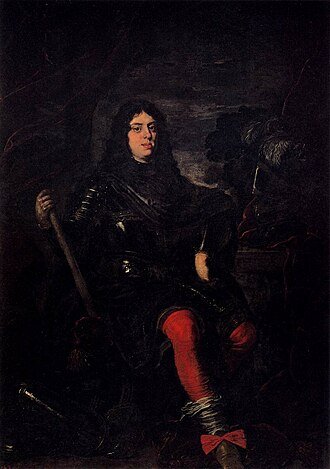


Portrait of Galileo Galilei painted by Justus Sustermans in 1640, according to its catalogue record. The sitter appears alongside a telescope, the instrument linked to his astronomical observations, which is the element that most clearly identifies the subject. It is a restrained portrait that focuses on the scientist himself and on his connection with the science of his time.

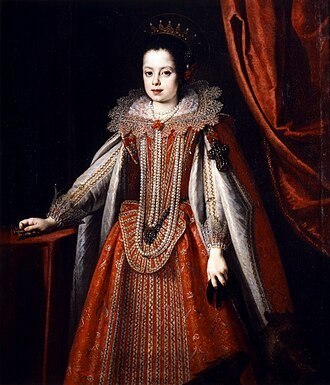
This 1629 oil on canvas by Justus Sustermans presents Victoria della Rovere in the guise of Saint Margaret, joining a portrait of a real sitter with a saint's identity, as the title makes clear. The available information does not establish the commission or original setting with certainty, so the reading rests mainly on the title and the portrait format. The painting is held at the Palazzo Martelli.

Portrait of Vittoria della Rovere, Grand Duchess of Tuscany, painted in 1655 by Justus Sustermans and held at the Medici villa in Poggio a Caiano. The work belongs to the court portrait genre and presents the sitter with the dignity expected of her rank. Sustermans, a painter of Flemish origin active at the Tuscan court, worked in oil on canvas to fix the likeness of the Medici family. Beyond these basic facts, the available record does not allow firm conclusions about its composition or iconography.

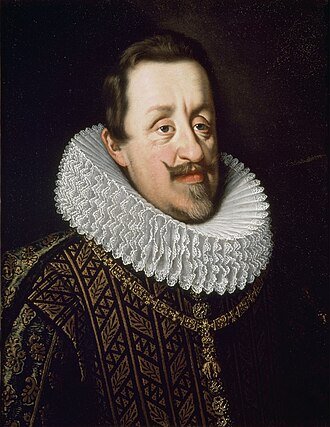
Oil on canvas portrait of Ferdinand II of Habsburg, dated 1623 and painted by Justus Sustermans. It is a fairly small-scale portrait in which the artist focuses attention on the emperor's face and bearing. The record offers no further details about its commission or original setting, so it is best described without adding speculation.
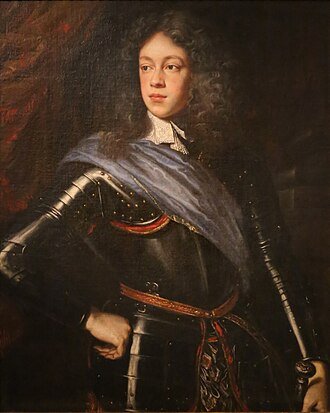

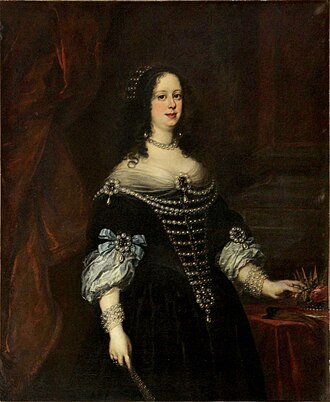
Portrait of Vittoria della Rovere, an oil on canvas painted in 1653 by Justus Sustermans. It belongs to the portrait genre, with the sitter's figure at the centre of the composition. Details about who commissioned it or the circumstances of its creation are not documented here, so any reading should stay close to what the image shows.

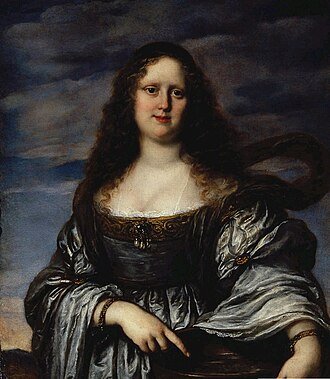
This portrait of Vittoria della Rovere, painted by Justus Sustermans in 1637, shows the sitter dressed as Tuccia, a figure linked to ancient Rome. It belongs to the portrait historié genre, in which a real person takes on the attributes of a historical or legendary character. Its interest lies in that blend of likeness and classical allusion.

Painted by Justus Sustermans in 1640 on a small copper plate, a support that favoured fine detail and a glossy oil surface. The sitter, Vittoria della Rovere, is portrayed as Saint Margaret of Antioch, a figure from Christian tradition, which gives the portrait a devotional and representative character. Its small format suggests an intimate use, closer to a collector's object than to a large painting.
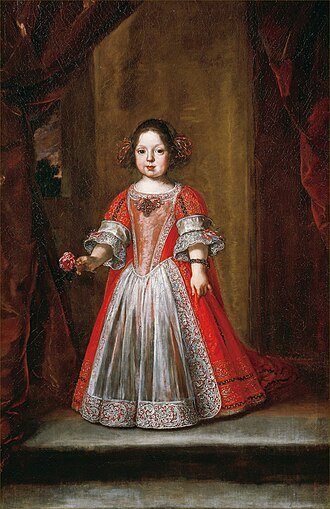
Portrait of Anna Maria Louisa de' Medici as a child, painted by Justus Sustermans in 1670. The girl is shown with the formality typical of Florentine aristocratic portraiture of the period, and the work belongs to the court portraits this Flemish painter produced for the Medici family. Further details about its commission or symbolism are not available in the information at hand.

The painting merges a religious theme, the Holy Family, with portraits of members of the Medici family. Vittoria della Rovere appears as a mother alongside her son Cosimo III, while Ferdinando II also features in the scene. It is an example of historical portraiture that places a contemporary family within a sacred subject.

Where to see the work
- Uffizi Gallery Florence · 7
- Galleria Palatina Florence · 6
- Villa Medicea of Poggio a Caiano Poggio a Caiano · 2
- Biblioteca Museu Víctor Balaguer Barcelona · 1
- Flint Institute of Arts Flint · 1
- Kunsthistorisches Museum Vienna · 1
- Royal Museums Greenwich · 1
- Museo Poldi Pezzoli Milan · 1
- Galleria Estense Modena · 1
Teachers and pupils
Studied with
- Maerten de Vos 1532–1603
- Frans Pourbus the Younger 1569–1622
Pupils
- Anton Domenico Gabbiani 1652–1726
Curiosities
Three portraits of Galileo
Three portraits of Galileo Galilei, the scientist who observed the sky through a telescope, are attributed to him. Two of them appear in catalogues dated 1636 and 1640. The presence of such a famous astronomer among the Medici sitters shows how closely the painter moved within the intellectual circle of the Florentine court.
An impossible date
Among the works attributed to him is The Family of Darius III in front of Alexander the Great, which the catalogue dates to 1600, when the painter was barely three years old. This inconsistency casts doubt on either the dating or the attribution. The canvas is held in the Biblioteca Museo Víctor Balaguer in Villanueva i Geltrú, Spain.
Saint, mythological figure, grand duchess
Vittoria della Rovere appears in several guises: as Flora, as Tuccia, and as Saint Margaret in different versions. These titles suggest that the paintings blended portraiture with allegory and religious or mythological figures. The sitter could thus be recognised by her face while also embodying the character she was shown as.