Kanō Naizen (1570-1616) was a Japanese painter of the Kanō school, one of the most influential families of painters in Japan at the close of the Azuchi-Momoyama period and the start of the Edo period. He is best remembered for his byōbu folding screens depicting the nanban, or "Southern Barbarians", the term used for Europeans who reached Japan.
He was the middle son of the school's head, Kanō Eitoku, and worked alongside his father and brothers in the main Kanō workshop in Kyoto. There the family took part in restoring imperial buildings, Buddhist temples and Shinto shrines that had been destroyed during the Kamakura period and the Genpei Wars. He was also adopted into the family line of Kanō Sanraku, another celebrated painter of the school. When he formally entered the school he took the name Naizen; his personal name was Shigesato.
His style is often overshadowed by that of his father and brothers, yet his nanban screens hold a distinct interest. Among them is Festivals of Toyokuni, produced in 1605 for the seventh anniversary of the death of Toyotomi Hideyoshi, who was venerated under the posthumous name Toyokuni Daimyōjin.
Between 1610 and 1615 he moved to Edo, the new administrative capital, at the request of the Tokugawa shogunate under Tokugawa Ieyasu, which had recently risen to power. His work remains part of the legacy of the Kanō school and of the pictorial record of Japan's contacts with the West.
Works (1)
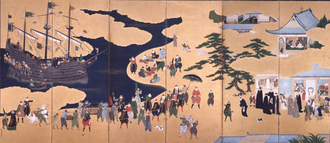
Screen attributed to the Kanō school, dated around 1600, belonging to namban art, the Japanese painting genre showing Europeans who arrived by sea. Its scenes reportedly include a ship, Franciscan and Jesuit missionaries, merchants and horses, along with references to Kirishitan Christians and the Dutch chief of the trading post in Japan.
Teachers and pupils
Studied with
- Kanō Shōei 1519–1592