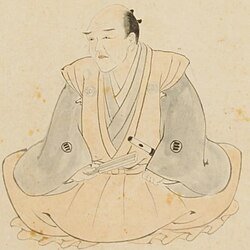
Kanō Takanobu (1571–1618) was a Japanese painter of the Kanō school, active during the Azuchi–Momoyama period. Born in Kyoto, he is best known as the father of Kanō Tan'yū, one of the school's most prominent painters.
He was the youngest son of the school's head painter, Kanō Eitoku, and younger brother of Kanō Mitsunobu. When his uncle Kanō Naganobu moved to Edo, the new administrative capital of the Tokugawa shogunate, around 1610–15, Takanobu stayed in Kyoto, where his commissions suggest he was valued by the court. At that time only he and Naganobu had the skill to lead branches of the school.
With financial backing from the shogunate, Takanobu conceived and supervised the painted decoration of the new palace of Emperor Go-Mizunoo, completed in 1614, and applied finishing touches to many sliding panels there and in nearby buildings. Twenty panels depicting thirty-two Chinese sages in the throne room of the shishin-den are attributed to him. They are among the few surviving works by him and the oldest surviving paintings from that hall.
After his death in 1618, his son Kanō Naonobu headed the Kyoto branch, and Takanobu's youngest son Yasunobu later continued that line, though both eventually moved to Edo.
Teachers and pupils
Studied with
- Kanō Eitoku 1543–1590