Kobayashi Eitaku
1843–1890 · Japanese painter and illustrator of the Meiji era
Kobayashi Eitaku (1843-1890), also known as Sensai Eitaku, was one of the most prominent Japanese painters and illustrators of the Meiji period, an era of experimentation in which Japanese art opened itself to Western influences. Born in Edo, present-day Tokyo, he combined a traditional training with a remarkable capacity for reinvention.
His training began early. He was adopted by Kano Eishin and, at about twelve or thirteen, became an apprentice in the Kano school under Kano Eitoku Tatsunobu. Shortly afterwards he worked as official painter for Ii Naosuke, lord of Hikone, which earned him samurai status. After his patron was assassinated in 1860, he left the Kano school to devote himself to ukiyo-e, a shift probably aided by the painter Kawanabe Kyosai.
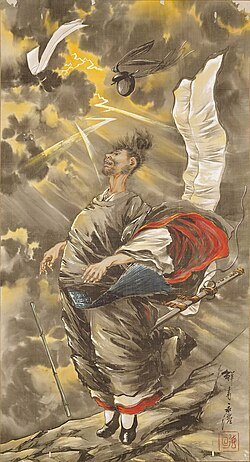
Eitaku blended the nanga tradition, Ming painting and Western styles, without ever fully abandoning what he had learned at the Kano school. From around 1870 he produced colour prints, illustrated newspapers and books, and made woodblock series on the modernisation of Japan, among them the Ryounkaku, the country's first Western-style skyscraper. His works most valued abroad include Sugawara Michizane Praying on Tenpai-zan, held by the Museum of Fine Arts, Boston, and the Izanagi and Izanami picture showing the creation of the Japanese islands.
For decades his work was little esteemed in Japan, as was that of other late ukiyo-e artists, and it was in the West that he received greater attention. Today he is recognised as a bridge between tradition and modernity in the Japanese art of his time.
Works (1)
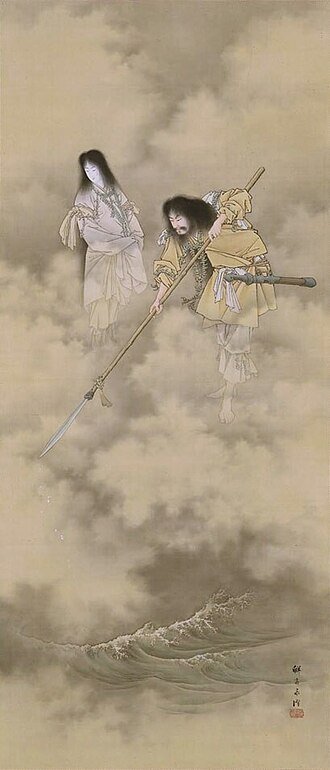
The painting shows the deities Izanagi and Izanami, central figures in the Japanese creation myth, alongside the heavenly spear Ame-no-nuboko, which in the story is linked to the forming of the archipelago. Dated 1880 and by Kobayashi Eitaku, it compresses the episode into a single vertical scene.
Where to see the work
- Museum of Fine Arts Boston Boston · 1
Teachers and pupils
Pupils
- Yoshitoshi 1839–1892