Konrad Witz
1400–1445 · German and Swiss painter of the Late Gothic, active in Basel
Konrad Witz (Rottweil, c. 1400-1410 – Basel, winter 1445 or spring 1446) was a German and Swiss painter, active mainly in Basel and one of the last representatives of Late Gothic painting in the Upper Rhine. He matters because his works show an unusual interest, for his time, in rendering three-dimensional space and landscape with precision.
He moved to Basel, drawn by the ecumenical council held there from 1431, and by 1434 he appears in the painters’ guild records under the name Konrad von Rottweil. In 1435 he acquired Basel citizenship and married Ursula Treyger, a niece of the painter Nikolaus Ruesch. They had five children. Almost all of his surviving works date from the last twelve years of his life; the rest are lost.
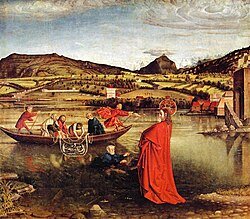
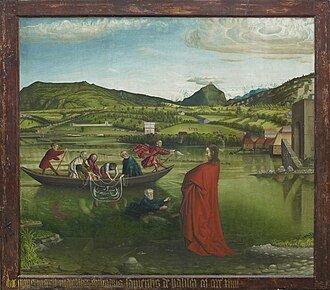
His career centres on three altarpieces, all surviving only in part. The earliest is the Heilsspiegel Altarpiece, of about 1435, now mostly in Basel with isolated panels elsewhere. Next comes the Altarpiece of the Virgin, of about 1440, associated with panels in Basel, Nuremberg and Strasbourg. The last is the St. Peter Altarpiece of 1444, painted for Geneva, which contains The Miraculous Draft of Fishes. This panel is regarded as the earliest faithful portrayal of a landscape in European art, based on observation of real topographical features. Independent works such as St. Christopher or the Annunciation in Nuremberg show his command of cast shadows to create depth and his attention to surfaces and textures.
His style pairs sturdy, monumental figures with dignified, static scenes, in contrast to the emotive manner of earlier German painters. Although he was one of the great innovators of northern European painting, he had little influence on later German art and was largely forgotten until Daniel Burckhardt published a monograph on him in 1901.
Works (8)
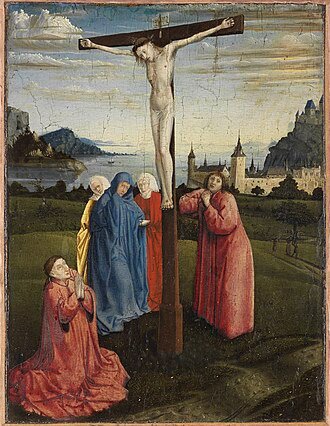
Konrad Witz painted this small oil panel in 1440. It shows the Crucifixion of Jesus in an intimate format, likely meant for private devotion rather than a large altarpiece. The available information does not clarify its original setting or commission, so it is best approached through its religious subject and its modest scale.
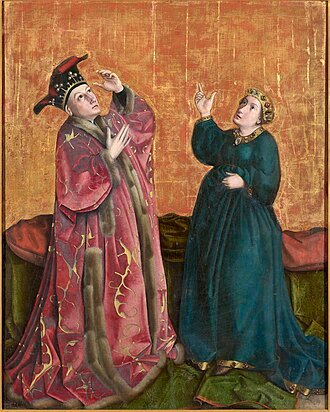
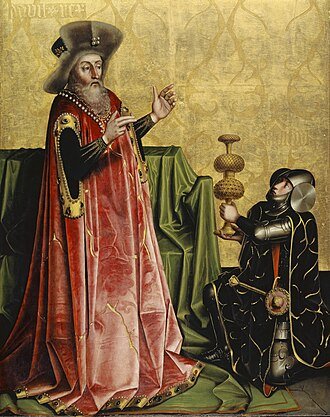
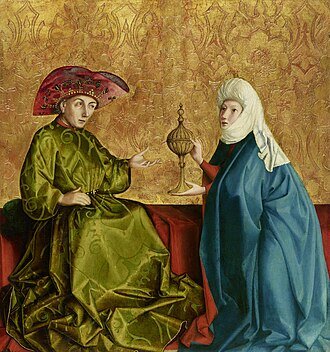
The panel shows Emperor Augustus and the sibyl Albunea, the two figures named in the work's title. Painted in oil on oak by Konrad Witz in 1435, it belongs to the religious altarpiece genre, and its German title refers to a mirror of salvation. Beyond these basic facts, little can be stated with certainty about its commission or original setting.
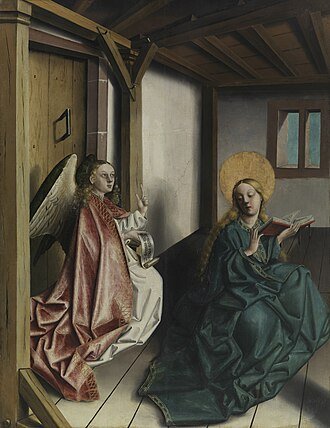
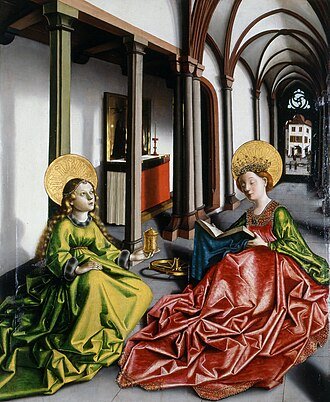
A religious work dated 1442 and attributed to Konrad Witz, depicting the Annunciation: the moment the angel tells Mary she will bear a child. It is held at the Germanisches Nationalmuseum. Its technique is recorded as oil on canvas and panel, a combination that should be checked carefully before being accepted as fact.
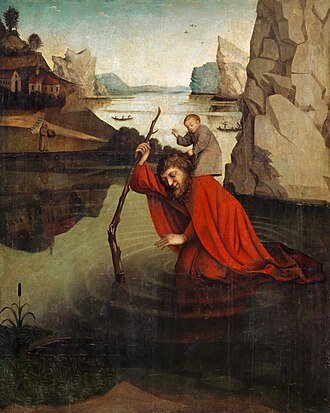
Saint Christopher, painted around 1440 by Konrad Witz on an oak panel, shows the saint wading across a river with the infant Jesus on his shoulders, leaning on a staff. The record lists mixed media and a religious subject. It is best described cautiously: the scene combines the monumental figure of the saint with a river landscape, a theme common in devotional painting of the period.
Where to see the work
- Kunstmuseum Basel Basel · 2
- Gemäldegalerie Berlin Berlin · 2
- Museum of Art and History Geneva Geneva · 1
- Musée des Beaux-Arts de Dijon Dijon · 1
- Germanisches Nationalmuseum Nuremberg · 1
Curiosities
Humour in some scenes
Some of his works contain ironic and humorous motifs that look surprisingly modern for their time. These are discreet details that historians read as the painter's winks rather than as central elements of the religious scene, something striking within Late Gothic art.
A death dated by a document
A document of 1446 records him as already deceased, so his death is placed between late 1445 and early 1446. Little else survives about his private life, so the Basel records remain the main source for tracing his steps in the city.