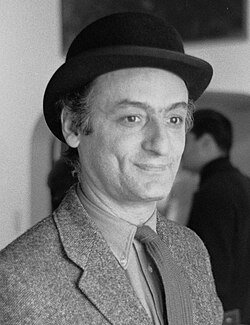
Larry Rivers
1923–2002 · American painter associated with Pop art and the New York School
Larry Rivers (Bronx, New York, 1923 - 2002) was an American painter who also worked as a musician, sculptor, and filmmaker. Many scholars regard him as the "Godfather" of Pop art, since he was one of the first artists to merge non-objective, non-narrative art with narrative and objective abstraction. Before committing fully to painting, he played jazz saxophone in New York.
Born Yitzhok Loiza Grossberg to Jewish immigrants from Ukraine, he took the name Larry Rivers in 1940, after being introduced as "Larry Rivers and the Mudcats" at a New York music venue. Between 1940 and 1945 he worked as a jazz saxophonist in the city and studied at the Juilliard School in 1945-46, where he worked alongside Miles Davis, a friendship that lasted until Davis's death in 1991. He took up painting in 1945, trained at the Hans Hofmann School from 1947 to 1948, and later earned a degree in art education from New York University in 1951.
His work was quickly acquired by the Museum of Modern Art in New York. Rivers reproduced everyday objects of American popular culture and adapted the freedom of Willem de Kooning's Abstract Expressionist technique to figurative ends. In 1955 he was one of eleven New York artists in the opening exhibition of the Terrain Gallery. In 1965 he had a major retrospective across five important American museums, and his final work for it, The History of the Russian Revolution, later went on permanent display at the Hirshhorn in Washington, DC. In the early 1960s he lived at the Hotel Chelsea, where he hosted French nouveau realisme artists.
During the 1970s he worked on video with Diana Molinari and Michel Auder, and also in neon. In 1971 he curated Some American History in Houston, an exhibition that drew criticism from the press and from several African-American artists, who felt the show centred on Rivers's own perspective as a non-Black artist rather than elevating the Black artists it included. His primary gallery was the Marlborough in New York, and in 2002 a major retrospective of his work was held at the Corcoran Gallery of Art in Washington, D.C. His legacy is tied to figurative Pop and the blending of artistic languages, although his career is also marked by the controversy surrounding that exhibition.