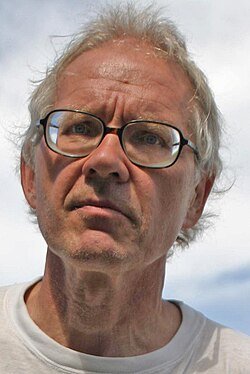
Lars Vilks
1946–2021 · Swedish artist, painter and driftwood sculptor
Lars Vilks (Helsingborg, 1946-Markaryd, 2021) was a Swedish artist with a doctorate in art history from Lund University, known above all for his driftwood sculptures and for the controversy caused by his drawings of Muhammad. He began painting in the 1970s and, although he was a self-taught artist, his career combined painting with sculpture and theoretical reflection.
Between 1988 and 1997 he worked at the National Academy of Fine Arts in Oslo, and from 1997 to 2003 he taught art theory at the National Academy of the Arts in Bergen. As a theorist he defended the institutional theory of art, and in his own writings he sometimes discussed his artistic activities in the third person.
In the early 1980s, in the context of postmodernism and conceptual art in Sweden, he created Nimis and Arx, sculptures made entirely of driftwood and located in the Kullaberg nature reserve, in Höganäs. In 1996 he proclaimed the area around these sculptures a micronation called Ladonia. Swedish critics generally treated his work with disdain, regarding it as mere provocation, yet media attention turned the site into a tourist attraction.
In 2007 he made a series of drawings depicting the prophet Muhammad as a roundabout dog. After several galleries refused to show them, the publication of one of the drawings in a regional newspaper provoked protests and international condemnation, and Vilks had to live under police protection. His legacy is tied to the debate over freedom of expression and provocative art rather than to a specific painting or sculpture movement.