Laurent de La Hyre (Paris, 1606-1656) was one of the leading French painters of the first half of the seventeenth century and a key figure of Parisian classicism. His work sits between the late Mannerism and the Baroque introduced by Simon Vouet. His orderly compositions and sober tone influenced the next generation of French painters, especially Eustache Le Sueur.
He trained under Georges Lallemand, but his real education came from studying the works of Primaticcio at Fontainebleau, since he never travelled to Italy. His first known paintings, dated 1630, include Pope Nicholas V Opening the Crypt of St. Francis of Assisi, made for the Capuchin friars of the Marais. They combine Mannerist architectural frames with figures of a more classical taste. Around 1635 and 1637 he worked for the Parisian goldsmiths' guild, producing St. Peter Healing the Sick and The Conversion of St Paul.
In 1639 he married the daughter of the head of the bodyguard of Louis XIII, which opened the doors of court circles to him. When his father-in-law died, he inherited a fortune that allowed him to move to a country house. Free from the pressure of patrons, he turned to mythological scenes and landscapes with ruins, where the influence of Poussin is evident, as in The Birth of Bacchus (1638). In 1648 he was one of the founders of the Royal Academy of Painting and Sculpture in Paris.
From then on his painting grew more archaic. His figure compositions look cold, under the influence of Poussin and Philippe de Champaigne, while his landscapes reached a more personal style, though never the naturalism of the Flemish masters. Anthony Blunt judged him not a great master but a painter who embodied the good sense and good taste of seventeenth-century French culture.
Works (14)
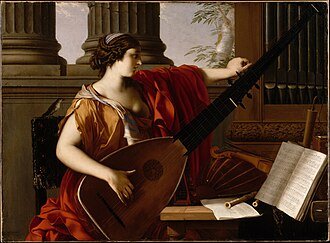
This allegory by Laurent de La Hyre, dated 1649, shows a woman surrounded by a lute, a violin, a book and birds. The instruments point to the world of music, while the female figure embodies the idea of music in allegorical form. With the available information, it is not possible to determine the commission or the meaning of each element.
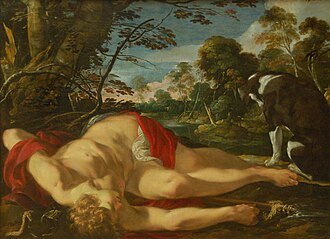

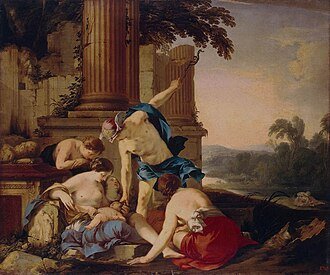
Mythological painting by Laurent de La Hyre, dated 1638 and held in the Hermitage Museum. It shows Mercury handing the young Bacchus over to a group of nymphs, an episode from classical myth in which the god of wine is entrusted to their care. The calm scene centres on the divine messenger and the nymphs who receive the child.
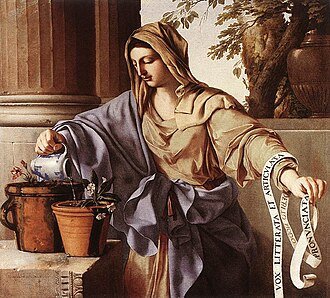
A work by Laurent de La Hyre dated 1650, belonging to the allegorical genre. Its title suggests that Grammar is personified as a figure, a common device in seventeenth-century painting for conveying abstract ideas through recognisable figures and scenes. Without further documentation, it is best approached cautiously, focusing on its composition and symbolic meaning as they appear on the canvas.
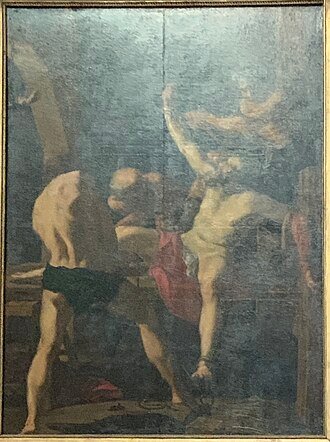
Laurent de La Hyre painted this canvas in 1637, depicting the martyrdom of Saint Bartholomew, one of Christ's apostles. It is held at the Church of St Vincent. The available information does not clarify the commission or the circumstances of its making, so its composition, colour and handling of the figure are best judged in person.
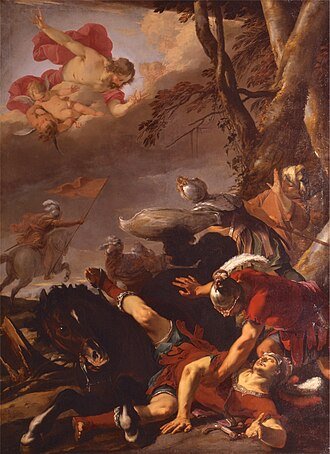
Painted by Laurent de La Hyre in 1637 on canvas, this religious work depicts the biblical episode of the conversion of Saint Paul. No further details are available about its commission, composition or provenance, so any reading of its style or symbolism should be approached with caution.

Oil on canvas dated 1642 by Laurent de La Hyre, a seventeenth-century French painter. It shows the Virgin Mary with the Christ Child in an intimate moment: mother and son face each other, and the child seems to reach toward her for a kiss. The scene stresses tenderness rather than ceremony, a common approach in religious painting of the period. It is held by the Louvre.

Religious painting by Laurent de La Hyre, dated 1635 and executed on canvas on a large scale. It depicts Saint Peter healing the sick, an episode tied to his apostolic ministry. Given its dimensions, it was probably conceived for a sacred setting, and it is now held in the cathedral of Notre-Dame de Paris.
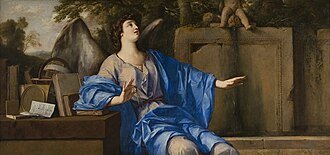
This allegory by Laurent de La Hyre, dated 1649, was painted in oil on canvas in a wide, horizontal format. It is classed as an allegory, but without further documentation its figures and precise message cannot be confidently identified. The work is held at the Musée des Beaux-Arts in Orléans, where it can be seen in person.
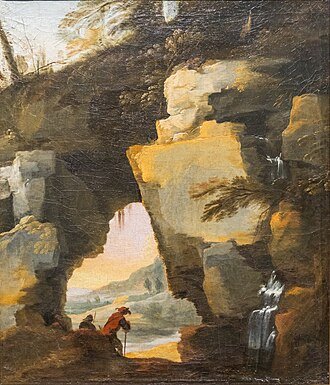
Landscape with the Rock Gate is a work by Laurent de La Hyre showing a natural stone arch as its central motif, set within vegetation and open ground. It belongs to the genre of landscape painting, where nature takes precedence over the human figure. Without further documentation on its commission or reception, it is best described cautiously, focusing on the subject and composition.

Painted by Laurent de La Hyre in 1648, this canvas revisits the Book of Job: a righteous man who loses everything in a wager between God and the devil and later sees his fortune, health and family restored thanks to his faithfulness. Departing from the usual imagery, which shows Job as a sick, humiliated old man, the painter shows him already healed, set among crumbling Renaissance buildings that suggest both his fall and his recovery.

The painting shows Cornelia alongside her sons, the Gracchi, at the moment she turns down the crown offered by King Ptolemy. Set before a temple, the figures wear togas within a composition that reads as orderly and clear. Laurent de La Hyre painted this oil on canvas in 1646, and the work is now held by the Museum of Fine Arts in Budapest.
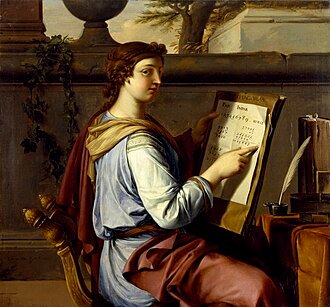
This work belongs to the allegorical genre: rather than narrating a specific episode, it presents a field of knowledge, arithmetic, through symbols. Laurent de La Hyre painted it in 1650 in oil on canvas. To read it, it helps to look closely at the objects and gestures around the figure, since in painting of that period such elements worked as visual keys to meaning.
Where to see the work
- Louvre Museum Paris · 2
- Metropolitan Museum of Art New York City · 1
- Art Institute of Chicago Chicago · 1
- Hermitage Museum Saint Petersburg · 1
- National Gallery London · 1
- Church of St Vincent Mâcon · 1
- Conservation of Religious and Civil Works of Art · 1
- Notre-Dame de Paris Paris · 1
- Musée des Beaux-Arts d'Orléans Orléans · 1
- Wallraf–Richartz Museum Cologne · 1
- Chrysler Museum of Art Norfolk · 1
- Museum of Fine Arts, Budapest Budapest district XIV · 1
- Walters Art Museum Baltimore · 1
Teachers and pupils
Pupils
- François Chauveau 1613–1676
Curiosities
An engraving by his own hand
The Conversion of St Paul, commissioned by the goldsmiths' guild, also exists as an engraving made by La Hyre himself. This allowed the composition to circulate beyond the church for which it was painted, using a technique different from oil. It is an unusual case of a painter translating his own compositions into the language of the print.
An annual commission for almost eight decades
Between 1630 and 1707 the Parisian goldsmiths' guild kept up the custom of commissioning one painting each year, presented in May. Of the 77 works by several artists gathered from that period, only about thirteen survive at Notre Dame, among them La Hyre's Conversion. The figure shows how fragile the survival of these series has been.
Drawings treated with the same seriousness
La Hyre did not reserve his seriousness for canvases alone. His drawings, of which the British Museum holds a fine example, The Presentation of the Virgin in the Temple, were treated with the same care as his paintings. At times they show a simplicity and dignity of effect that make them especially valued.