
Lemuel Francis Abbott
1760–1802 · English portrait painter of the late 18th century
Lemuel Francis Abbott (born Lemuel Abbott in Leicestershire, 1760 or 1761 – London, 1802) was an English painter who specialised in portraiture. The son of the clergyman Lemuel Abbott and his wife Mary, he became a pupil of Francis Hayman in 1775 and moved to London. His work offers a window onto late eighteenth-century British society, since he painted naval officers, scientists, writers, artists and businessmen of the period.
After Hayman's death in 1776 he returned to his parents and continued to develop his talent on his own, although some authorities suggest he may also have studied with Joseph Wright of Derby. Around 1780 he married Anna Maria and settled again in London, where he lived for many years. He exhibited at the Royal Academy but never became a member. His portrait of Horatio Nelson is his best-known work, alongside likenesses of other naval officers such as Robert Calder and Thomas Pasley, and of figures such as the astronomer William Herschel and the poet William Cowper.
Around the age of forty he suffered a mental breakdown, which is thought to have been caused by overwork from his many commissions and by domestic unhappiness. He was treated by Thomas Munro, chief physician at Bethlem Hospital and a specialist in mental disorders, who also attended King George III. Abbott died in London in 1802. His legacy rests mainly on his portraits of the British elite, which record the faces and fashions of his age.
Works (3)

This 1797 portrait by Lemuel Francis Abbott shows the Neoclassical sculptor Joseph Nollekens. He was famous for busts of political figures such as William Pitt and Charles James Fox, which were produced in quantity. Here the sitter leans on his bust of Fox, a direct reference to that output. The painting was not shown during the artist's lifetime and later entered the National Portrait Gallery in London as a gift.

A half-length portrait of Admiral Horatio Nelson in rear-admiral's uniform, covered in honours including the Order of the Bath star and decorations from Naples and the Ottoman Empire. His hat carries the diamond plume given by Sultan Selim III after the Battle of the Nile, while the empty sleeve of the arm lost at Santa Cruz is folded across his chest. Lemuel Francis Abbott painted several Nelson likenesses; this best-known version was commissioned by his friend Alexander Davison.
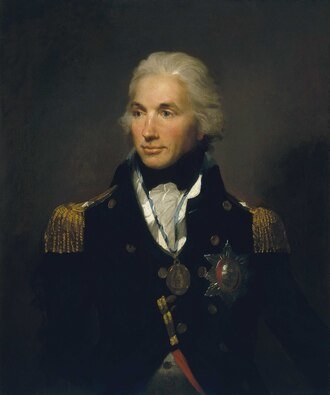
Painted in 1798 in oil on canvas by Lemuel Francis Abbott, this portrait depicts Rear-Admiral Sir Horatio Nelson, as its title indicates. As a portrait, its focus falls on the sitter's face and bearing rather than on a narrative scene. The work is held by the National Maritime Museum.
Where to see the work
- National Portrait Gallery London · 1
- Royal Museums Greenwich · 1
- National Maritime Museum Royal Borough of Greenwich · 1
Teachers and pupils
Studied with
- Francis Hayman 1708–1776
Curiosities
A golfer in the portrait
Among his paintings is the portrait of Henry Callender, captain general of the Blackheath Golf Club, which is considered one of the earliest depictions of the game of golf. Reproductions of it hang in golf clubs around the world. The original was sold at Bonhams in London on 9 December 2015.
A signature with an added name
Some of his paintings are signed "Francis Lemuel Abbott", using a Christian name that was not among those he was baptised with. It is not known why he assumed the extra name. One such signature appears on a plate dedicated to the society of golfers at Blackheath, which is dated 1790.