
Léon Frédéric
1856–1940 · Belgian Naturalist and Symbolist painter
Léon Frédéric (1856-1940) was a Belgian painter who became a leading figure of Naturalism and Symbolism. Born in Brussels into a prosperous family, he was first apprenticed to an architect and decorative painter, then trained at the Académie Royale des Beaux-Arts in Brussels, where he worked under Jean-François Portaels. After a study trip to Italy between 1878 and 1879, his art drew on Italian Quattrocento painting and early Flemish masters. He matters because he joined an academic realism to a mystical and social view of rural life.
His debut at the Brussels Salon brought him close to Jules Bastien-Lepage and to the artist group L'Essor. Around 1883 he settled in Vresse-sur-Semois, in the Belgian Ardennes. In the 1890s his painting took on a more allegorical character, with precise drawing, cool colour and a strong debt to the Pre-Raphaelites. He often chose the triptych format, as in The Ages of Workers (1895-1897, Musée d'Orsay, Paris) or The Stream (1897-1900, Royal Museums of Fine Arts of Belgium, Brussels), where country labour carries a moral weight.
He exhibited at the Brussels Salon, with the Essor circle and at the Salon d'Art Idéaliste, and won awards at international fairs. After his marriage he made his final home in Schaerbeek in 1899. He was appointed a member of the Académie Royale in 1904, and in 1929 King Albert I made him a baron. His legacy lies in bringing social and spiritual concerns into the Symbolist idiom, and his works are held in museums in Belgium and France. A street in Schaerbeek now bears his name.
Works (6)

The painting presents two children from a rural Walloon background. Its title, Les Boëchelles, uses a term the record does not explain, so the specific identity of the sitters remains uncertain. Painted in 1888 in oil on canvas, it is held at the Royal Museum of Fine Arts Antwerp. Its interest lies mainly in the direct, unembellished gaze the artist gives his young subjects, rather than in any narrative scene.

Oil on canvas by Léon Frédéric, painted in 1886 and held at the Museum of Fine Arts in Ghent. The title, The Funeral Meal, points to a gathering held after a burial, suggesting a scene of shared mourning, probably with relatives and friends present. Beyond these basics, the record offers no reliable details on its commission or composition, so any further reading should remain tentative.
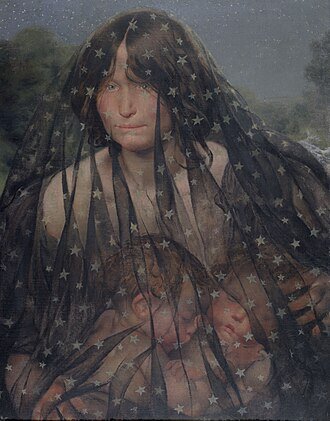
Painted in 1891 by Belgian artist Léon Frédéric, this oil on canvas is an allegory: rather than recording a specific event, it turns the idea of night into a symbolic image. Its genre signals that meaning lies in the overall concept rather than in narrative detail. The painting is held at the Museum of Fine Arts in Ghent.

Painted by Léon Frédéric in 1905, this oil on canvas is known by a title that links death and resurrection through God's love. The available information does not describe its composition or who commissioned it, so any reading of its figures should be approached with caution. The title alone suggests a religious and hopeful theme.

Symbolist work by Léon Frédéric dated 1890, an oil on canvas of large horizontal format. It shows a stream running through a wood, with a child and swans, in an allegorical composition of contemplative tone. Without further reference material, it is best read as a symbolic scene about nature and childhood, without assigning it a specific meaning.

Where to see the work
- Museum of Fine Arts Ghent (MSK) Ghent · 2
- Royal Museums of Fine Arts of Belgium Brussels-Capital Region · 2
- Royal Museum of Fine Arts Antwerp Antwerp · 1
- Ohara Museum of Art Kurashiki · 1
Teachers and pupils
Studied with
- Jean-François Portaels 1818–1895
- Ernest Slingeneyer 1820–1894
Curiosities
Italy paid for by his father
His father financed his study trip to Italy from 1878 to 1879, which took him to Naples, Rome, Florence and Venice. His favourite painters were Sandro Botticelli and Domenico Ghirlandaio. Earlier, from 1876 to 1878, he had entered the Prix de Rome without success, so his Italian training came through a different route than the official prize.
Live nude models in a shared studio
In 1875, together with several fellow art students, he rented a private studio where they could paint from live, nude models. It was a way to practise outside the academy and gain confidence with the human figure. The sources do not say how long the arrangement lasted or what specific results it produced.
A Russian admirer
The young Alexandre Benois greatly admired his work and, in 1898, arranged for several paintings to be bought by Princess Maria Tenisheva for an exhibition in St. Petersburg. In this way his work reached Russia while his name was already circulating through major European exhibitions.