
Lodewijk Toeput, known in Italy as Ludovico Pozzoserrato, was a Flemish painter who worked mainly in the Veneto, especially in Treviso, in the late sixteenth and early seventeenth centuries. He was probably born around 1550, but neither the date nor the place of his birth is known for certain. The biographer Karel van Mander placed it in Mechelen, while many modern historians favour Antwerp, where he is believed to have trained under Maerten de Vos. After travelling through Florence, Rome and Venice, he is documented in Treviso in 1582, and he lived there for the rest of his life, dying between 1604 and 1605.
He is best known for his frescoes and canvases of landscapes and formal gardens with banquets and music-making, which blend Flemish and Venetian traditions. He also painted biblical scenes, allegories and mythological subjects from Ovid's Metamorphoses, and he is regarded as the leading figure of late sixteenth-century painting in Treviso. His frescoes survive in Padua, Treviso and Conegliano, where he covered the exterior façade of the cathedral.
His influence can be seen in the next generation of Flemish landscape painters, among them Joos de Momper, Tobias Verhaecht and the Valckenborch brothers.
Works (6)

This 1504 painting by Lodewijk Toeput belongs to religious art and presents the Virgin Mary, the central figure of the biblical scene of the Annunciation. Beyond its title and date, the available information says little about its commission or composition, so any further reading should be approached cautiously. It is kept in Conegliano Cathedral.

This oil on canvas, dated 1579 and attributed to Lodewijk Toeput, presents a pleasure garden with a maze. The available information does not clarify who commissioned it or where it was first displayed, so the scene is best read as a view of a carefully laid-out garden, where the maze suggests a space designed for strolling and diversion.

An oil on canvas dated 1577, the picture takes its subject from its title: a fire at the Doge's Palace. The available information does not establish what caused the blaze, when exactly it occurred, or what the painter meant to show. The work is held at the Complesso di Santa Caterina.
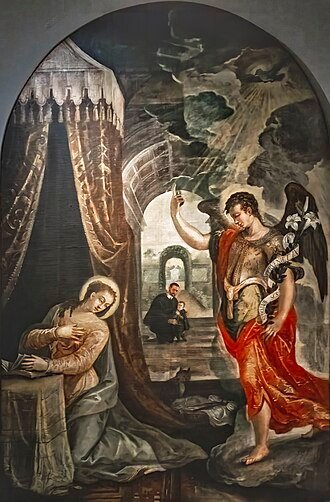
This painting brings together two familiar subjects of religious art: the Annunciation, where the angel tells Mary of her role in the sacred story, and a donor portrait, the person who commissioned or paid for the picture and appears within the scene. Painted in oil on canvas in 1550, it shows how devotion and the patron's presence could share one image.


This oil portrait shows a man whose identity is unknown, so the work is known by the generic title Portrait of a Nobleman. The genre focuses attention on the face and presence of the sitter rather than on a narrative scene. It is attributed to Lodewijk Toeput, though information about the commission behind it is limited.
Where to see the work
- Complesso di santa Caterina Treviso · 3
- Conegliano cathedral Conegliano · 1
- Royal Collection · 1
- Musei civici di Treviso Treviso · 1
Curiosities
A translated name
His Italian name is a literal translation of Toeput, which can be read as ‘closed well’. After settling in Treviso he began to call himself Lodovico Pozzo da Trevigi, so the city gave him an Italian identity that stayed with him for the rest of his career.
Frescoes for a pawnshop
Treviso had strong demand for art from religious and civic patrons. For the Monte di Pietà, a communal pawnshop, he painted frescoes of scenes from the Old and New Testaments and parables alluding to the works of mercy, a commission that linked art with a public social role.
Seasons and months
He left many drawings of the seasons and months of the year. His Allegory of Spring and Allegory of Winter, now in the Yale University Art Gallery, probably inspired Joos de Momper's own treatment of the subject, showing how he served as a model for the Flemish landscape painters who followed him.