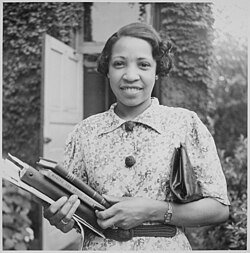
Loïs Mailou Jones (Boston, 1905-1998) was an American painter and educator whose career spanned more than seven decades. She is remembered as one of the African American artists who took painting beyond the portrait, drawing on African and Caribbean subjects and her own travels.
Her training began in design. Between 1919 and 1927 she studied in Boston, where she won a design scholarship and worked on costumes, including pieces for Denishawn inspired by her interest in African masks. Around 1930 she committed to painting, although textile design shaped her early professional years.
During the Harlem Renaissance she visited Harlem often. The work of Aaron Douglas influenced her painting The Ascent of Ethiopia, and in Negro Youth (1929) one can already see profiles and shading inspired by African masks, a device she kept throughout her career. She lived as an expatriate in Paris in the 1930s and 1940s, and her travels through Europe, Africa and the Caribbean changed the way she painted.
She taught at the Palmer Memorial Institute in North Carolina and, from 1930, at Howard University, where she remained until her retirement in 1977. She received many awards, including the Robert Woods Bliss Prize for landscape in 1941 and the title of Chevalier of the National Order of Honor and Merit of Haiti in 1954.
She believed her greatest contribution was to prove the talent of Black artists, and she wished to be known simply as an American painter, without labels. Her work is held by the Metropolitan Museum of Art and the Smithsonian American Art Museum. After her death, Chris Chapman's biography Lois Mailou Jones: A life in color and the 2009 retrospective at the Mint Museum in Charlotte kept her work in view.