Lorenzo Veneziano
1336–1390 · Venetian painter of the International Gothic
Lorenzo Veneziano was a Venetian painter active, according to his documented work, between 1356 and 1372. He is regarded as the most important painter of the Venetian school of his time. His significance lies in moving away from the Byzantine models still dominant in Venice and adopting a greater naturalistic curiosity drawn from northern Gothic art, especially from Bohemia. In this way he became one of the most representative artists of the International Gothic style.
Biographical information is scarce, and the birth and death dates given in different sources vary, so they should be treated with caution. He is thought to have trained with Paolo Veneziano, although no evidence confirms this. His early works show the Byzantine manner then in fashion. He worked mainly in Venice but also in Verona, Bologna and Vicenza, perhaps because he did not secure regular commissions from the Venetian Republic.
His earliest documented work, from 1356, has been lost. Among the surviving pieces, the Annunciation altarpiece stands out. It was made for the high altar of the church of Sant'Antonio di Castello and is now in the Gallerie dell'Accademia in Venice. It shows the donor Domenico Lion, Christ in blessing and several saints. Its expressive faces, more dynamic drapery and abandonment of the Byzantine habit of letting dark underpaint show through the flesh reveal his new direction. Other works include a Crucifix in San Zenone in Verona, a Death of the Virgin in Vicenza Cathedral and a portable triptych in the Thyssen-Bornemisza Museum in Madrid.
His legacy is visible in later Venetian painters such as Guglielmo Veneziano, Catarino Veneziano and Stefano di Sant'Agnese, who took up his style. Today he is seen as a key link between Byzantine painting and the International Gothic in Venice.
Works (4)

Religious polyptych attributed to Lorenzo Veneziano and dated 1400, now held at the Gallerie dell'Accademia in Venice. Its subject is the Annunciation, when the angel Gabriel tells Mary she will bear Christ, a theme widely found in devotional art. As a polyptych, it is made of several joined panels, a format commonly used for altarpieces.
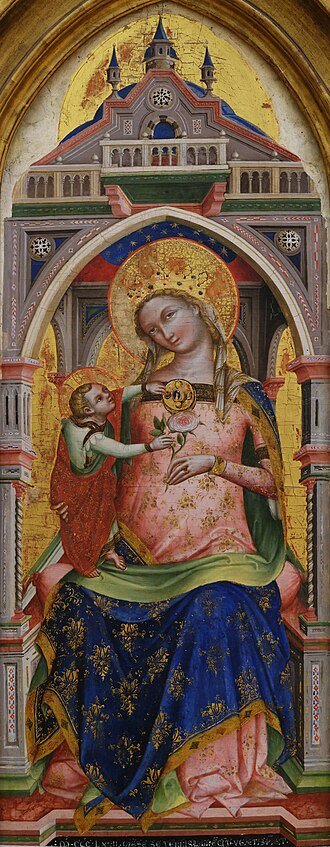
Religious work dated 1372 and attributed to Lorenzo Veneziano, painted in gold and tempera on poplar panel. It shows the Virgin Mary seated on an architectural throne topped by a pediment, with the Christ Child on her lap. The tall, narrow format recalls altarpieces of the period, though the record does not establish its original location or the circumstances of its commission.
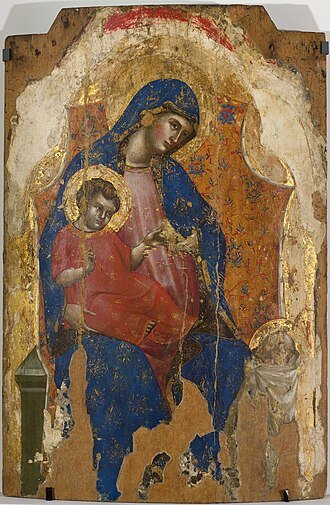
A devotional painting by Lorenzo Veneziano, dated 1370 and executed in tempera, showing the Virgin Mary holding the infant Jesus. The available information does not allow us to confirm the original commission or the setting for which it was made. The work is held at the National Museum in Warsaw.
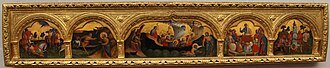
This panel, dated to around 1400 and attributed to Lorenzo Veneziano, presents scenes from the lives of the apostles Peter and Paul, two central figures of early Christianity. It is held at the Gemäldegalerie in Berlin and belongs to religious art. The available information does not reveal its commission or original setting.
Where to see the work
- Gallerie dell'Accademia Venice · 1
- Louvre Museum Paris · 1
- National Museum in Warsaw Warsaw · 1
- Gemäldegalerie Berlin Berlin · 1
Curiosities
A name that split in two
For a time the artist was identified with a painter who signed himself 'Lorenzo pentor di S Marina' in 1379. Historians have gradually abandoned that identification, so the date of his death remains uncertain in the sources that report it.
A donor painted into the altarpiece
On the Annunciation altarpiece, an inscription names the patrician Domenico Lion as the commissioner, and his portrait appears within the work beside the central scene. Including the patron in religious paintings was a common practice in commissions of the period.