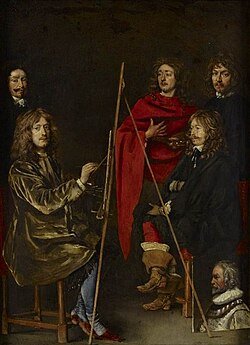
Louis Le Nain was one of three brothers who painted in seventeenth-century France, alongside Antoine and Mathieu. Born in Laon, he is most often credited with the scenes of rural life that form the core of the group's best-known work. Because the three signed their paintings only with the family name and their styles are very similar, they are usually treated as a single entity, known as Le Nain.
His genre paintings show peasants and families with a literal yet sympathetic tone, never grotesque or mocking. Many of these figures, however, look more like townspeople spending their leisure in the countryside, as in The Milk Woman's Family, so their true social class remains open to question. The brothers also made miniatures and portraits; the portraits are linked to Mathieu, who became the official painter of Paris.
Antoine and Louis both died in 1648. After a period of neglect, their work was rediscovered in the nineteenth century, when its plainness and static poses drew admiration. It probably influenced realist painters such as Millet and Courbet.
Works (10)


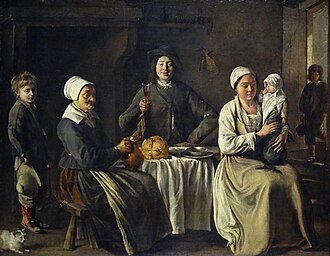
A genre scene dated 1642 and held at the Louvre, it shows a peasant family with members of different ages, from a small infant to an elderly man. Among the objects are bread, a cup of drink, a clay jug and a domestic cat, details that point toward everyday rural life in the household.

Genre scene painted by Louis Le Nain in 1645, in oil on canvas. Judging by its title, the work seems to focus on a visit to a grandmother, a family encounter within everyday domestic life. As a genre scene, its main interest lies in depicting an ordinary moment rather than a historical or religious subject.

This allegory shows a nude woman with a wing and a helmet, beside a corpse and a palm branch, set on an open plain. The combination of attributes probably points to a military victory, though its precise meaning is not securely documented. It is an oil on canvas from 1635, held at the Louvre.
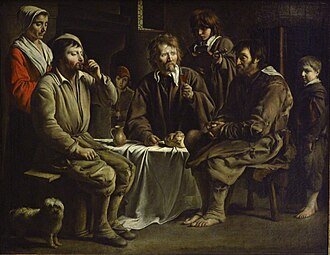
This genre scene by Louis Le Nain, dated 1642 and held at the Louvre, shows a peasant family gathered around a plain table. Bread, a drink, a child and a dog are visible, while a man and a woman share the meal. The painting invites viewers to look at rural everyday life with a quiet, restrained attention, avoiding anecdote or caricature.
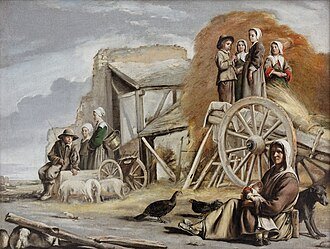
Louis Le Nain painted this scene of a peasant driving a cart, joined by a woman, a boy, a girl, a dog and a pig. The figures belong to rural life and appear without heroic gestures or drama, seen with a plain, close gaze. Dated 1641, the canvas is now in the Louvre, Paris.
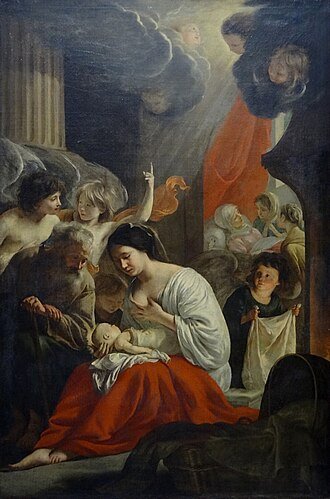

This painting shows a blacksmith at his forge, joined by a woman, a child and a peasant who complete the scene. The dark interior is organised around the forge, which provides the main source of light. Dated 1640, it focuses on people of modest condition in their working surroundings and the everyday life around them.
Where to see the work
- Louvre Museum Paris · 6
- Hermitage Museum Saint Petersburg · 1
- National Gallery London · 1
- Crozat Collection · 1
- Notre-Dame de Paris Paris · 1
Curiosities
Doubtful birth dates
For a long time it was believed that Antoine and Louis were born in 1588 and 1593. These dates have been disputed, and it has been suggested that they may have been born just before and just after 1600. The uncertainty affects the chronology of painters who left almost no individually signed works.
From neglect to the Louvre
The Le Nain paintings were revived in the 1840s. Thanks to the efforts of Jules Champfleury, a writer and friend of the realist painter Gustave Courbet, they entered the Louvre in 1848. Champfleury also wrote about French popular art, an interest that matched these scenes of peasant life.
The brother with honours
Mathieu became the official painter of Paris in 1633 and was named a knight. He lived until 1677, almost three decades longer than Antoine and Louis, who died in 1648. His long career contrasts with the modest fame his brothers enjoyed for centuries.