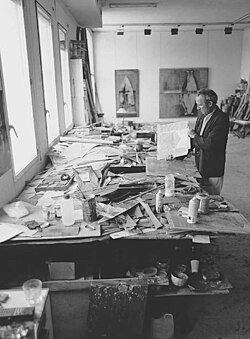
Lucio Muñoz
1929–1998 · Madrid-born abstract painter, a leading figure of Spanish Informalism
Lucio Muñoz (Madrid, 1929-1998) was one of the leading figures of Spanish Informalism in the second half of the twentieth century. His training combined drawing classes with work in his family's grocery shop; in 1949 he enrolled at the Academy of San Fernando in Madrid, where he befriended realist artists such as Antonio López.
After a trip to Paris in 1954, he showed his first non-figurative works in 1955 at the Dintel gallery in Santander. A French state scholarship in 1956 brought him into contact with the Informalism of Dubuffet, Fautrier, Wols and Tàpies, and he never abandoned abstraction. From 1958 he worked with wood, scratched, burned, carved or left to decay, a material that became the hallmark of his painting. He took part in the Venice Biennale and Documenta in Kassel, and in 1964 he became the first painter to hold a solo show at the Juana Mordó gallery.
His output also includes large-format printmaking and murals, among them the apse of the Aránzazu basilica in Oñati and the mural presiding over the plenary hall of the Assembly of Madrid, hung days after his death. In 1983 he received Spain's National Prize for Plastic Arts.