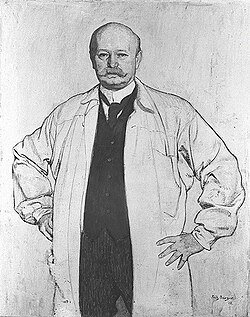
Karl Ludwig Manzel (Neu Kosenow, 1858 - Berlin, 1936) was a German sculptor of modest origins, active mainly in Berlin during the reign of Wilhelm II. His career gained momentum in the mid-1890s, when he received commissions for statues for Berlin Cathedral and the Reichstag, as well as several imperial monuments in Prussian provincial towns.
Manzel trained at the Berlin Academy of Fine Arts, where he studied under Albert Wolff and Fritz Schaper. Before devoting himself fully to sculpture, he earned a living from drawings published in newspapers such as Ulk and Lustige Blätter. After winning the Academy's Grand Prize, he spent three years in Paris and in 1889 settled in Berlin as an independent sculptor.
His works include the statue La Paz defendida por las armas, the Apostles for Berlin Cathedral and the statue of Henry III the Black for the Reichstag. Among his imperial commissions are the monument to Frederick I of Brandenburg on the Siegesallee and busts of Wilhelm II. He presided over the Prussian Academy of Arts on two occasions and ran a studio at the Berlin School of Arts and Crafts, where Josef Thorak was among his students.
Late in his career he returned to painting and produced altarpieces for churches in Charlottenburg. His most ambitious work, a large high relief of Christ with 24 figures, was worked on between 1909 and 1924.