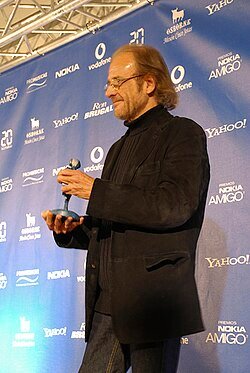
Luis Eduardo Aute
1943–2020 · Spanish singer-songwriter, painter, filmmaker and poet
Luis Eduardo Aute (Manila, 1943-Madrid, 2020) was a Spanish singer-songwriter, painter, filmmaker and poet. Although he is remembered mainly as a songwriter, painting was his first vocation and the one he regarded as his main pursuit for much of his career. Born in the Philippines to Spanish parents, he settled permanently in Madrid in 1954, and his work links song, image and writing.
Childhood between Manila and Madrid
Aute grew up in Manila, where he attended a La Salle school and learned English and Tagalog, alongside Spanish and Catalan at home. He drew and painted from an early age, and a Super 8 camera given by his parents let him make films with friends. At eleven, in 1954, the family settled in Madrid, where he continued his education and, as a teenager, won a silver medal at the second Youth Art Competition, influenced by German Expressionism.
Painter, cinema and first songs
In 1960 he held his first solo painting exhibition at the Galería Alcón in Madrid, which was well received. After leaving technical architecture studies soon after starting them, he spent time in Paris, where he discovered Jacques Brel and Georges Brassens. He worked in film as an assistant on international productions, including Joseph L. Mankiewicz's Cleopatra. During his military service and a trip to Brazil he listened to Bob Dylan and Joan Baez, and that influence produced songs such as Rosas en el mar and Aleluya #1, which became hugely successful internationally, although at first he offered them to other performers, including Massiel.
Records, withdrawal and return
He released his first album, Diálogos de Rodrigo y Gimena, in 1967, but in 1968 he left music, disillusioned with the industry, and recorded 24 canciones breves, a social chronicle of Spain at the time. For a while he also turned to literature, writing science fiction stories, and to film. In the early 1970s he returned to music, and in 1970 he published a poem in the magazine Poesía 70 that led to the magazine's closure.
Legacy
Aute left a body of work in which painting, singer-songwriter music, film and poetry intertwine. His song Aleluya was covered in many countries, and his career made him a reference figure in the Spanish culture of his time.