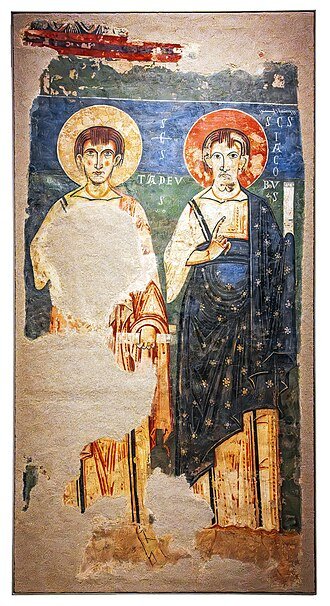
The Master of Pedret is the name historians give to a Romanesque fresco painter active in Catalonia in the early twelfth century. He takes his name from the church of Sant Quirze de Pedret, where part of his most representative work once stood and is now held by the Museu Nacional d'Art de Catalunya in Barcelona. He is considered a major figure in European Romanesque painting.
His works appear in widely separated places, from the Catalan Pyrenees to the cathedral of Saint-Lizier in France, consecrated in 1117, which suggests he travelled at the head of a team taking commissions. In the Lleida area, remains survive at Sant Pere del Burgal, Santa Maria d'Aneu, Sant Joan de Tredòs and the collegiate church of Sant Pere d'Àger.
At Sant Pere del Burgal, a life-size female figure, identified by the historian Ainaud as Lucia, wife of Count Artau of Pallars Sobirà, offers a chronological clue: as a widow she governed those lands between 1081 and 1090. The figures are hieratic and set in pairs between the windows of the apse. One frieze shows the Iron Crown of Monza, which has led some to suggest northern Italy as the painter's origin, a view supported by iconographic and technical parallels with the Ticino region. The subjects come from the Old and New Testaments, painted in vivid, brilliant colours with a spontaneous brushwork.
Works (1)
Where to see the work
- Museu Nacional d'Art de Catalunya Barcelona · 1