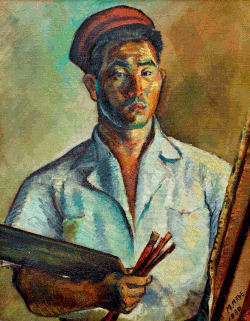
Manabu Mabe
1924–1997 · Japanese-born Brazilian painter, a pioneer of abstract art in Brazil
Manabu Mabe (Udo, Japan, 1924 – São Paulo, 1997) was a Japanese-born Brazilian painter regarded as one of the pioneers of abstract art in Brazil. His family emigrated to Brazil in 1934 and settled on coffee plantations in the interior of São Paulo state, where he worked in the fields, taught himself Portuguese by lamplight and drew on scraps of paper. That hard early life shaped his self-taught training.
His first solo exhibition in São Paulo, in 1948, mixed Eastern calligraphy with a painting of spots and stains that became his signature. In the following years he gained recognition at the second São Paulo International Biennial in 1953, and at the fifth Biennial, where he received the prize for best national painter, as well as international honours at the Paris Biennial in 1959. He also took part in the Japan Art Biennial in 1956.
In 1979 about 150 of his paintings were lost when a Varig cargo plane bound for Rio de Janeiro disappeared over the Pacific, and he later remade some of them. A retrospective at the São Paulo Museum of Art (MASP) followed in 1986, and in 1996 he travelled to Japan for a major show. His works are held in museums in São Paulo, Rio de Janeiro, Boston and Dallas. He died in São Paulo in 1997 after complications from a kidney transplant. His legacy sits alongside that of other Japanese-Brazilian artists who helped establish abstraction in the country.