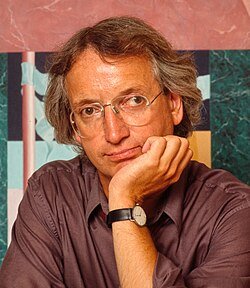
Michael Graves
1934–2015 · American architect, product designer and teacher
Michael Graves (Indianapolis, 1934 - Princeton, 2015) was an American architect, product designer and teacher, and one of the most visible figures of Postmodernism in the United States. His buildings keep the clean lines of modern design but add classical elements that give them a warmer, less technical character.
He studied architecture at the University of Cincinnati and at Harvard University. After two years as a fellow at the American Academy in Rome, he set up his practice in Princeton, New Jersey, in 1964, and in 1972 began teaching at Princeton University. He was one of the five members of the Five Architects, also known as the New York Five, alongside Peter Eisenman, Richard Meier, John Hejduk and Charles Gwathmey.
Among his works are the Humana Office Building in Louisville, the Alexander House in Princeton, the Portland Building in Portland, Oregon, and the Ten Peachtree Tower in Atlanta. His firm also worked for The Walt Disney Company, designing the Team Disney building in Burbank, California, and the Dolphin and Swan resorts at Walt Disney World in Florida, including their furniture, signage and original artworks. In 2001 he received the AIA Gold Medal.
In the early 1980s, Ettore Sottsass invited him to join the Memphis Group, based in Milan. Around the same time Alessi commissioned him to design a sterling silver tea service, followed by a stainless steel kettle, the "9093", from 1984, with a bird-shaped whistle that sounds when the water boils. For about fifteen years it was the company's best-selling product. From then on, Graves was no longer known only as an architect. From the late 1990s he designed household goods for Target, which went on sale in 1999, and in 1994 he opened his own shop in Princeton.
After a serious infection left him paralysed from the waist down in 2003, he devoted much of his work to healthcare and disability design, redesigning everything from bedside tables to hospitals. In 2010 he presented prototype homes for wounded soldiers and took part in the Obama administration's work on accessibility design guidelines. His legacy lies both in postmodern architecture and in everyday design, where he showed that form could make objects easier and more pleasant to use.