
Michael Wolgemut
1434–1519 · German painter and woodcut designer from Nuremberg
Michael Wolgemut (Nuremberg, 1434 – Nuremberg, 1519) was a German painter and printmaker who worked mainly in Nuremberg. He belonged to the final phase of Gothic art, often called the Flemish style or early Renaissance, and his importance rests largely on his role as a teacher: at the head of a large workshop he trained Albrecht Dürer, who completed his apprenticeship there between 1486 and 1489. Little is known of his private life. He learned from his father, Valentin Wolgemut, and in 1472 he married the widow of his former master, the painter Hans Pleydenwurff, whose son Wilhelm worked as an assistant and, from 1491, as a partner. Around 1470 he is documented in Munich as an assistant to Gabriel Mälesskircher.
His workshop produced large altarpieces, other religious paintings and carved wooden altarpieces in high relief, richly gilded and coloured. Among his paintings are a four-panel altarpiece of 1465, now in the Munich gallery, and the high altar retable of St. Mary's church in Zwickau, completed in 1479, for which he received 1,400 gulden. In 1501 he was commissioned to decorate the town hall of Goslar, and as a portraitist he enjoyed great reputation. A portrait by him is held in the Thyssen-Bornemisza Museum in Madrid.
He was the leading woodcut artist of his time in Germany. He designed many book illustrations for Nuremberg publishers, above all for the Nuremberg Chronicle (1493) by Hartmann Schedel, where the volume and shadows of his blocks marked a clear advance in the technique. His legacy has partly been overshadowed by that of Dürer, who surpassed him within a few years. Today he is remembered as a bridge between late Gothic and the German Renaissance.
Works (1)
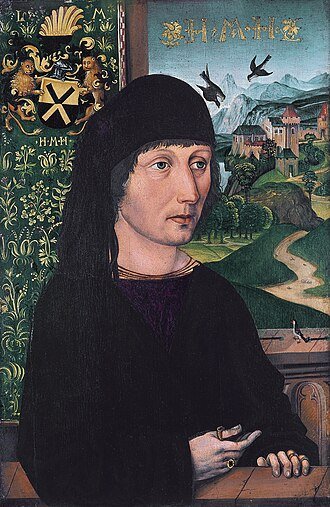
Portrait of Levinus Memminger, an oil on panel painting dated 1485 and attributed to Michael Wolgemut, a leading figure of German Renaissance art. It presents a calm-faced man in a small format typical of intimate portraiture. The record offers no details about who commissioned it or the circumstances of its making, so any reading of its context should be approached cautiously.
Where to see the work
- Thyssen-Bornemisza Museum Madrid · 1
Teachers and pupils
Studied with
- Hans Pleydenwurff 1420–1472
Pupils
- Alberto Durero 1471–1528
Curiosities
A heavily illustrated book
The Nuremberg Chronicle contains nearly two thousand woodcuts, many reused several times through the book with only the accompanying text changed. Each double-page print measures about 342 by 500 millimetres. It is considered one of the first bestsellers in history, and many copies survive, one of them at the Academia de San Fernando in Madrid.