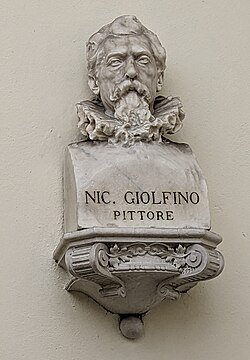
Niccolò Giolfino (Verona, c. 1476 – Verona, 1555) was an Italian Renaissance painter active mainly in Verona, where he produced mostly sacred subjects for local churches. He came from a family of sculptors in the city, and his father, Nicolò Giolfino, belonged to that tradition. His brother Paolo Giolfino also worked as a painter.
He trained in the workshop of Liberale da Verona, alongside Giovanni Francesco Caroto. His early works, such as the Pentecost of 1518 in Sant'Anastasia, show a linear quality and hard surfaces, somewhat distant from his master's manner. His initial style was eccentric yet conservative, still related to Late-Gothic art, with slender figures and agitated draperies.
His importance as a fresco painter rests on the decoration of the chapel of San Francesco at San Bernardino, carried out between 1512 and 1522, where he used scenographic devices to organise episodes from the life of Saint Francis. In the 1530s his frescoes in Santa Maria in Organo became smoother and more intensely coloured. In his mature years his forms grew more robust and active, as seen in the Arrest of Christ (1546) in the Cappella degli Avanzi.
He died in Verona in 1555. One of his pupils was Paolo Farinati, and his legacy is mainly recognised in the religious painting of Verona in his time.
Works (8)
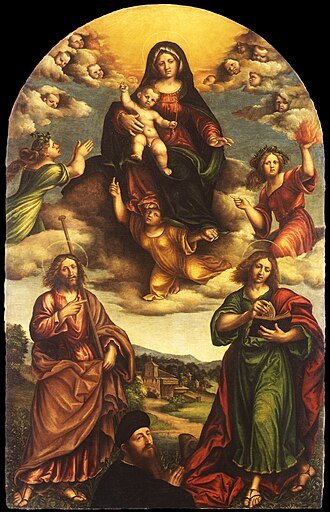
This religious painting, dated 1525 and attributed to Niccolò Giolfino, shows the Virgin holding the Child, who raises his hand in a gesture of blessing, with saints gathered around them. The arrangement, with holy figures sharing one space rather than acting out a story, relates to the sacra conversazione type. The available information does not establish the commission or the original setting of the work.

The work is painted in oil on panel, a support of wood widely used in earlier European painting. It is the work of Niccolo Giolfino and is held in the Castelvecchio Museum. Since the available information says nothing about its subject, date or commission, its iconography and context cannot be described with confidence.


This religious painting by Niccolò Giolfino, dated 1510, was executed in tempera on canvas, a less common choice than oil at the time. It is held at the Castelvecchio Museum. The subject and the commission are not recorded, so any iconographic reading should be approached cautiously. Its modest format may hint at a devotional purpose, though this cannot be confirmed.

This oil-on-panel painting by Niccolò Giolfino, a horizontal work, is held in the Castelvecchio Museum. It is classed as religious art, but the available information does not specify the scene depicted or the date of execution. Beyond these basic facts, little can be stated with confidence about the commission or original setting.
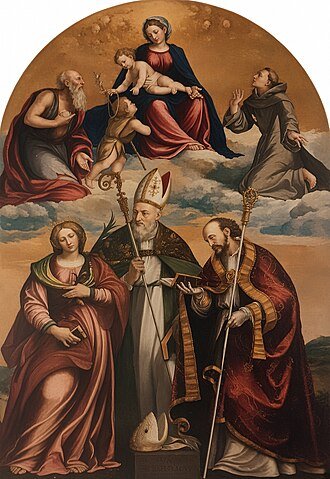
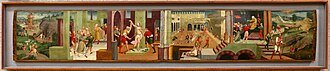
This is a religious painting by Niccolò Giolfino, executed in tempera on panel. The available record does not specify the scene depicted, the date or the commission, so it is not possible to say with certainty which sacred moment is shown or the circumstances of its creation. It is held at the Castelvecchio Museum.
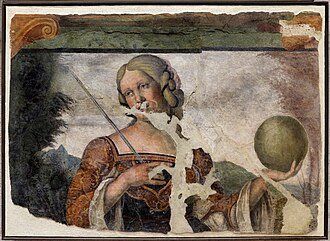
This 1530 allegory is a fresco by Niccolò Giolfino held at the Castelvecchio Museum. As an allegorical work, its meaning is conveyed through figures and symbols that invite interpretation of a broader message. The available information does not allow us to determine with confidence its commission or its precise meaning.
Where to see the work
- Castelvecchio Museum Verona · 7
- Gemäldegalerie Berlin Berlin · 1