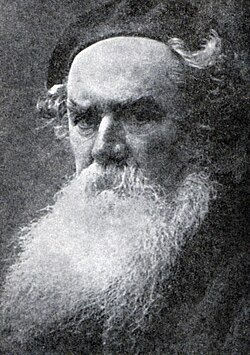
Octav Băncilă (Botoșani, 1872 – Bucharest, 1944) was a Romanian realist painter and left-wing activist. His importance lies in bringing peasants, factory workers, impoverished Jewish traders, conscripted soldiers and Roma people into the painting of his country. He was the brother of the feminist journalist Sofia Nădejde.
Orphaned at the age of four, he was raised in Iași by his much older sister, who encouraged his talent. He graduated from the Fine Arts School in Iași in 1893 and, between 1894 and 1897, on a scholarship, studied in Italy, France and Germany, where he worked under Nicholaos Gysis in Munich, though it is not known whether he ever graduated. On his return, financial difficulties kept him from setting up a studio in central Iași, so he settled on the outskirts, where he began exploring his main themes. From 1901 he taught art in the city's primary schools.
After the 1905 Russian Revolution he became involved in socialist circles. Following the crushing of the 1907 Romanian peasants' revolt, he travelled the country and produced a series of twelve paintings, some now lost, among them Înainte de 1907 ("Before 1907"), an old peasant standing with open arms, scenes of bodies piled in fields, and 1907, showing three ragged peasants running into rifle fire. During the First World War he became involved in pacifist causes. In 1916 he was appointed professor at the Fine Arts School in Iași, a post he held until his retirement in 1937.
In 1919 he co-founded, with Constantin Ion Parhon and Paul Bujor, the short-lived Workers' Party, soon merged into the Peasants' Party. He criticised social and political developments in Greater Romania, supported the strikes in the Jiu Valley and used his art against anti-Semitism. Towards the end of his life he sympathised with communism without joining the Communist Party of Romania. He died in Bucharest in 1944, and a street in Iași now bears his name.
Teachers and pupils
Studied with
- Gheorghe Panaiteanu Bardasare 1816–1900
Pupils
- Corneliu Baba 1906–1997
- Aurel Băeșu 1896–1928