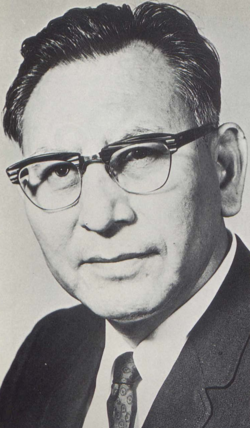
Oscar Howe (Dakota name Mazuha Hokshina, 'Trader Boy', 1915-1983) was a Yanktonai Dakota painter from South Dakota. He became known for his casein and tempera works, marked by bright color, dynamic motion and crisp lines, and he is regarded as a figure who paved the way for later Native American artists.
He studied at the Santa Fe Indian School from 1933 to 1938 and in 1940 was sent by the South Dakota Artists Project, a Works Progress Administration division, to learn mural techniques. After serving in World War II he earned a degree on the GI Bill and an M.F.A. from the University of Oklahoma in 1954. In the 1930s he painted murals for public buildings in South Dakota, and in 1957 he became a professor of art at the University of South Dakota, where he taught until his death.
His style grew out of traditional Sioux 'straight line' painting, rooted in hide and nineteenth-century ledger art, to which he added the spider-web pattern known as tohokmu. Critics compared his work to Cubism, but he rejected that label and situated it within Dakota ways of knowing. In 1958 a work was rejected from a Philbrook Museum show for not fitting 'traditional' Indian style; his protest helped open the community to abstraction.