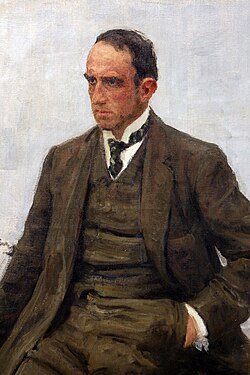
Paolo Troubetzkoy
1866–1938 · Italian-born sculptor of Russian origin, Belle Époque
Paolo Troubetzkoy (Intra, 1866 - Pallanza, 1938) was a sculptor of noble Russian descent, born in Italy, whose work is associated with Impressionism because of his ability to capture movement in bronze. Although he is best remembered as a sculptor, he also trained as a painter. He portrayed the society of the Belle Époque with a highly personal style of modelling.
He was the son of the Russian diplomat Prince Piotr Trubetskoy and the American singer Ada Winans, and grew up in a household open to the Milanese Scapigliatura. At the family villa he was taught painting by Daniele Ranzoni during childhood, and later studied sculpture with Giuseppe Grandi. He is described as largely self-taught. His first models were the horses in the family stables, and works such as Nella Stalla, Elefante and Bue were well received at a Venice art exhibition in 1887. Auguste Rodin and Medardo Rosso shaped his work, but he sought a personal language centred on expressing movement.
Among his early works is a portrait of the painter Giovanni Segantini (1896). An exhibition at the Hébrard gallery in Paris brought him recognition, with admiration from Rodin, though others did not understand his aims. Between 1897 and 1906 he taught sculpture at the Imperial Academy of Fine Arts in Moscow, and in 1900 he won the Grand Prix at the Paris Universal Exposition.
His best-known work is the equestrian statue of Tsar Alexander III, unveiled in St Petersburg in 1909. After the Russian Revolution it was moved to a courtyard of the Russian Museum, and after the dissolution of the Soviet Union it was placed in front of the Marble Palace. After leaving Russia he lived in Paris and in the United States, and in 1932 he returned to Italy, to Pallanza on Lake Maggiore, where he died in 1938.
A committed vegetarian, he was praised by his friend George Bernard Shaw, himself a vegetarian, as a humanitarian who could do anything with an animal except eat it. His legacy is preserved mainly in Verbania, where the Museo del Paesaggio holds more than three hundred of his plaster works.
Teachers and pupils
Studied with
- Francesco Filippini 1853–1895
- Giuseppe Grandi 1843–1894