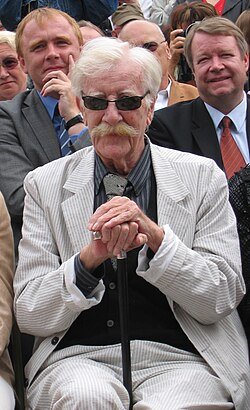
Paul Wunderlich
1927–2010 · German Surrealist painter, sculptor and graphic artist
Paul Wunderlich (Eberswalde, 1927 – Saint-Pierre-de-Vassols, 2010) was a German painter, sculptor and graphic artist. His Surrealist work combines dismembered, disproportioned bodies with references to mythological legends, and his erotic sculptures often focus on the nude.
After serving as a Flakhelfer and spending time as a prisoner of war, he settled with his mother in Eutin, where he finished school and attended the Palace School of Art in the Orangery of the castle. In 1947 he entered the Landeskunstschule in Hamburg, in William Tietze's Free Graphics class, and in 1950 he resumed his studies under Willem Grimm. From 1951 he taught lithography and etching at the Hochschule für bildende Künste Hamburg, and that same year he printed works for Emil Nolde. In 1952 he worked for Oskar Kokoschka on the lithograph suite "Ann Eliza Reed".
Around 1959 he left behind an early, essentially realistic period and developed his characteristic style. In the 1960s he was influenced by Art Deco and Art Nouveau. In 1960 the Hamburg prosecutor seized his lithograph cycle "qui s'explique" for indecent depictions. After moving to Paris in 1962, he returned to Hamburg in 1963 as successor to George Gresko, holding the professorship until 1968. From 1969 he made bronze sculptures and statues, influenced by Salvador Dalí.
In 1971 he married the photographer Karin Székessy, and the couple pursued art projects together. He lived and worked between Hamburg and Provence, where he died in 2010.