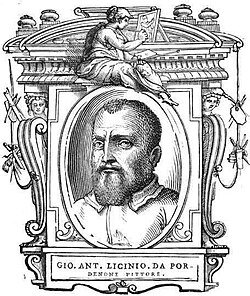
Giovanni Antonio de' Sacchis, known as Il Pordenone after his Friulian hometown, was an Italian Renaissance painter and one of the leading promoters of Mannerism in northern Italy. Born around 1483 near Pordenone and dying in Ferrara in 1539, he matters because he brought a more turbulent, dramatic style with illusionistic effects into Venetian painting.
He trained in a provincial setting, in the workshop of Pellegrino da San Daniele, with a style that still echoed the Quattrocento. Around 1510 his work began to show Venetian influence, which he had largely absorbed by the middle of the decade. He probably spent time in Rome between 1516 and 1518, where he drew on Raphael and Michelangelo, filtered through Sebastiano del Piombo, but gave those sources an energy that moved away from Classicism.
Between 1520 and 1521 he painted the fresco cycle of the Passion of Christ in the Cremona Cathedral, pushing his style to its limits: crowded scenes of figures in dramatic poses, with the landscape almost absent. From 1527 he settled mainly in Venice, where he rivalled Titian and even replaced him as official painter of the Republic. Many of his frescoes have been lost, including those in the Doge's Palace, destroyed in the fire of 1577. His mature style was more elegant, adapted to Venetian taste, without giving up expressiveness. In his last years his inventiveness seems to have faded. He died in Ferrara while preparing cartoons for tapestries for Duke Hercules II.
His direct legacy was limited: his son-in-law Pomponio Amalteo was a follower of only provincial importance. Some of his discoveries were taken up by Titian, and the gap he left in Venetian painting was partly filled by Tintoretto, the most clearly Mannerist of the great Venetian painters of the second half of the sixteenth century.
Works (7)

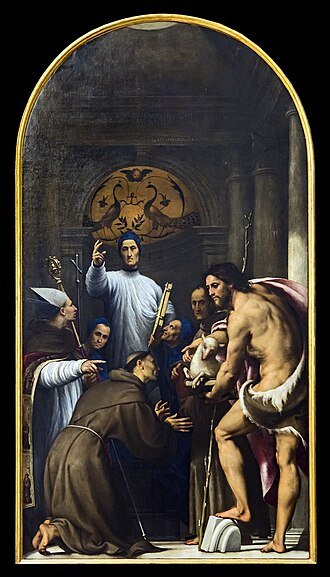
Painted in 1532 by Pordenone, this religious work shows Blessed Giovanni Giustiniani alongside several saints. It was executed in oil on canvas and is now held at the Gallerie dell'Accademia in Venice. Without further documentation, we can only describe the scene itself: a devotional gathering of sacred figures.

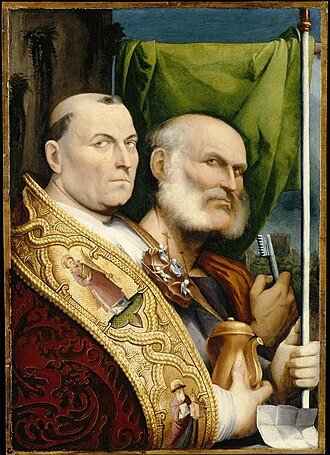
Oil on panel by Pordenone, dated 1515, showing Saint Peter alongside Saint Prosdocimus. The work belongs to religious painting. The available record gives no details about its commission or early history, so its original setting cannot be confirmed. Its interest lies mainly in the pairing of two saints within a devotional image.
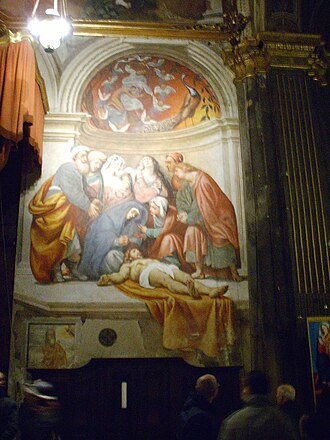
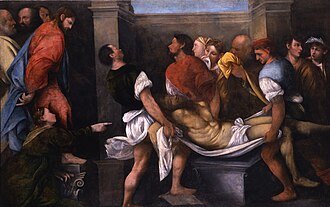
Work by Pordenone dated 1520 and housed in the cathedral of Cremona. It belongs to religious art and depicts Jesus of Nazareth after his death, within the scene of mourning that gathers around his body. The available record offers no further details on its commission, composition or technique, so its particular features cannot be stated with certainty.

This painting brings together Saint Martin of Tours and Saint Christopher of Lycia, two saints linked to charity and to the protection of travellers. The record places it at the Scuola Grande di San Rocco, but no reference texts specify its date, commission or circumstances of execution, so it is best to rely on what the painting itself shows and on its presence in this Venetian institution.
Where to see the work
- Pinacoteca di Brera Milan · 1
- Gallerie dell'Accademia Venice · 1
- Museo de arte de Carolina del Norte Raleigh · 1
- Scuola Grande di San Rocco Venice · 1
Teachers and pupils
Pupils
- Pomponio Amalteo 1505–1588
Curiosities
A rival who nearly took his place
Pordenone competed with Titian, the dominant figure of the Venetian art scene, in a rivalry that sometimes turned bitter. According to the sources, he even managed to replace the painter from Cadore as official painter of the Republic, a post of great prestige in the city. This contest shaped much of his career in Venice.
Frescoes lost in a fire
His decorations for the Doge's Palace, made between 1535 and 1538, vanished without trace in the fire of 1577. Many of his fresco works met the same fate, so today he is known mainly through written sources and the few pieces that survive.