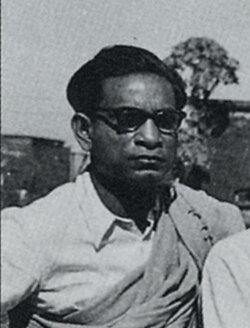
Quamrul Hassan
1921–1988 · Bangladeshi painter, printmaker and draughtsman
Quamrul Hassan (Calcutta, 2 December 1921 – Dhaka, 2 February 1988) was a Bangladeshi painter known in his country as Potua, a term usually linked to folk artists. His work blends the folk tradition, especially pata painting, with modern ideas such as Cubism, giving him a personal idiom that feels both down to earth and modern.
Born in Calcutta into a conservative family, he enrolled at the Government Institute of Arts in 1938, although his social and cultural commitments stretched the six-year course into nine years. After the partition of India he settled in Dhaka, and in 1948 he co-founded the Government Institute of Fine Arts with Zainul Abedin. During the liberation war he worked for the art division of the government's radio service, in exile.
He worked across nearly every medium, including oil, gouache, watercolour, etching and woodcut. His recurring subjects were the lives of the lower classes, rural women and political protest. His paintings of women are often grouped into three phases, shaped by memories of his mother, his marriage and a later separation. After the famine of 1974 his woodcuts took on a more angry tone. Goon Tana, Nabanna and Gorur Snan are among his best-known works.
His monstrous portrait of Yahya Khan and his satire of the dictator Ershad have made him a reference point in Bangladesh's political memory. He died of a heart attack while attending a poetry festival and was buried beside the central mosque of the University of Dhaka.