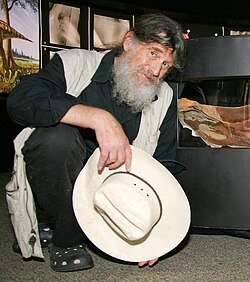
Robert Thomas Bakker (Ridgewood, New Jersey, born March 24, 1945) is an American paleontologist whose work helped reshape many theories about dinosaurs. He is not a painter, but his ideas have shaped the modern image of these animals, and with it the art that depicts them.
Bakker traced his interest in dinosaurs to an article he read in Life magazine in 1953. He studied at Yale under John Ostrom, a champion of the new view of dinosaurs, and later earned his doctorate at Harvard. He then taught anatomy at Johns Hopkins University in Baltimore and supervised the future paleoartist Gregory S. Paul. Most of his fieldwork took place at Como Bluff in Wyoming, though he also travelled to Mongolia and South Africa in search of dinosaur habitats.
In 1986 he published The Dinosaur Heresies, arguing that dinosaurs were warm-blooded. His evidence included their upright posture, which is common among warm-blooded animals today; the highly active lifestyle of dinosaurs such as Deinonychus; the presence of some species at high latitudes; the rapid rate of dinosaur speciation and evolution; and predator-prey relationships. He also pointed to the link between dinosaurs and birds and to the fast growth of dinosaurs, visible in cross-sections of their bones. This popular work brought him wide public attention.
Bakker also wrote the novel Raptor Red, which follows a year in the life of a female Utahraptor in the Early Cretaceous and draws on his knowledge of dromaeosaurid behaviour. He describes himself as an ecumenical Christian minister and holds that there is no real conflict between religion and science. He has advised believers and non-believers alike to read Saint Augustine, who argued against a literal reading of the Book of Genesis.