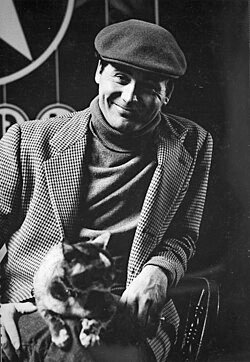
Robert Clark, known as Robert Indiana (New Castle, Indiana, 1928 - Vinalhaven, Maine, 2018), was an American painter, sculptor, costume designer and stamp designer associated with Pop Art. He is best known for his LOVE series, which made him famous around the world. He also worked on stage design and costumes for theatre, a side of his career mentioned here only briefly.
He studied at the Herron School of Art in Indianapolis and at the Munson-Williams-Proctor Institute in Utica, New York, between 1945 and 1948. He then continued at schools in Chicago and Maine, and in Edinburgh and London, until 1954. Once settled in New York, he befriended Richard Smith, Ellsworth Kelly and Jack Youngerman. His first series drew on traffic signs, slot machines and old commercial logos. In the early 1960s he made sculptural assemblages alongside a cool, multicoloured style built on short words such as EAT, HUG and LOVE, playing with symmetry and colour. In 1964 he also appeared in Andy Warhol's film Eat.
Unlike many Pop artists, he was more interested in American identity and culture than in mass media. The American Dream became the core of his mature work, treated in political pieces such as Alabama (1965), literary works such as The Calumet (1961), and self-portraits and studies of fame such as The Metamorphosis of Norma Jean Mortenson (1963-1967). After the September 11 attacks he painted the Peace Paintings, shown in New York in 2004. In 1978 he moved to Vinalhaven island, in Maine.
The LOVE image was created in 1964 as a Christmas card for MoMA. In 1973 the United States Postal Service issued an 8-cent stamp, the first of several love stamps. Its popularity led to countless reproductions and parodies in sculptures, posters and objects in many languages, and it inspired album and book covers. Because of this, some critics have labelled him an opportunist or a one-hit wonder, and Indiana was unable to copyright LOVE. His legacy lives on in public sculptures such as the one in Philadelphia's LOVE Park, a gathering place for local skaters, who later adopted the emblem as their own symbol.