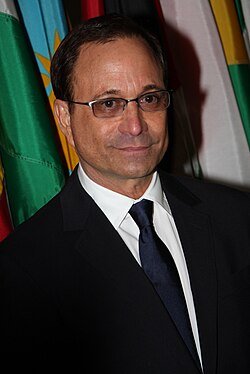
Ross Bleckner (Brooklyn, 1949) is an American painter who lives and works in New York City. Raised in a Jewish family, he became interested in art after seeing the exhibition The Responsive Eye at the Museum of Modern Art in 1965. He studied at New York University, where he worked alongside Sol LeWitt and Chuck Close, and later earned an MFA at the California Institute of the Arts. His first solo show took place in 1975 at the Cunningham Ward Gallery in New York, and from 1979 he was long associated with the Mary Boone Gallery.
His painting relies on symbolic imagery rather than direct representation. His canvases, with forms that seem to shift focus, explore change, loss and memory. Much of his work falls into series with motifs that recur and are recombined. From the late 1980s he addressed the AIDS epidemic, as in Small Count (1990), where white dots stand for white blood cells being destroyed, or Throbbing Heart (1994), whose red blotches recall the marks of Kaposi's sarcoma.
In 1995 the Solomon R. Guggenheim Museum staged a major retrospective of his work, and his paintings are held in collections including the Museum of Modern Art, the Whitney Museum of American Art and the Museo Reina Sofía. In 2009 he became the first fine artist named Goodwill Ambassador of the United Nations Office on Drugs and Crime.