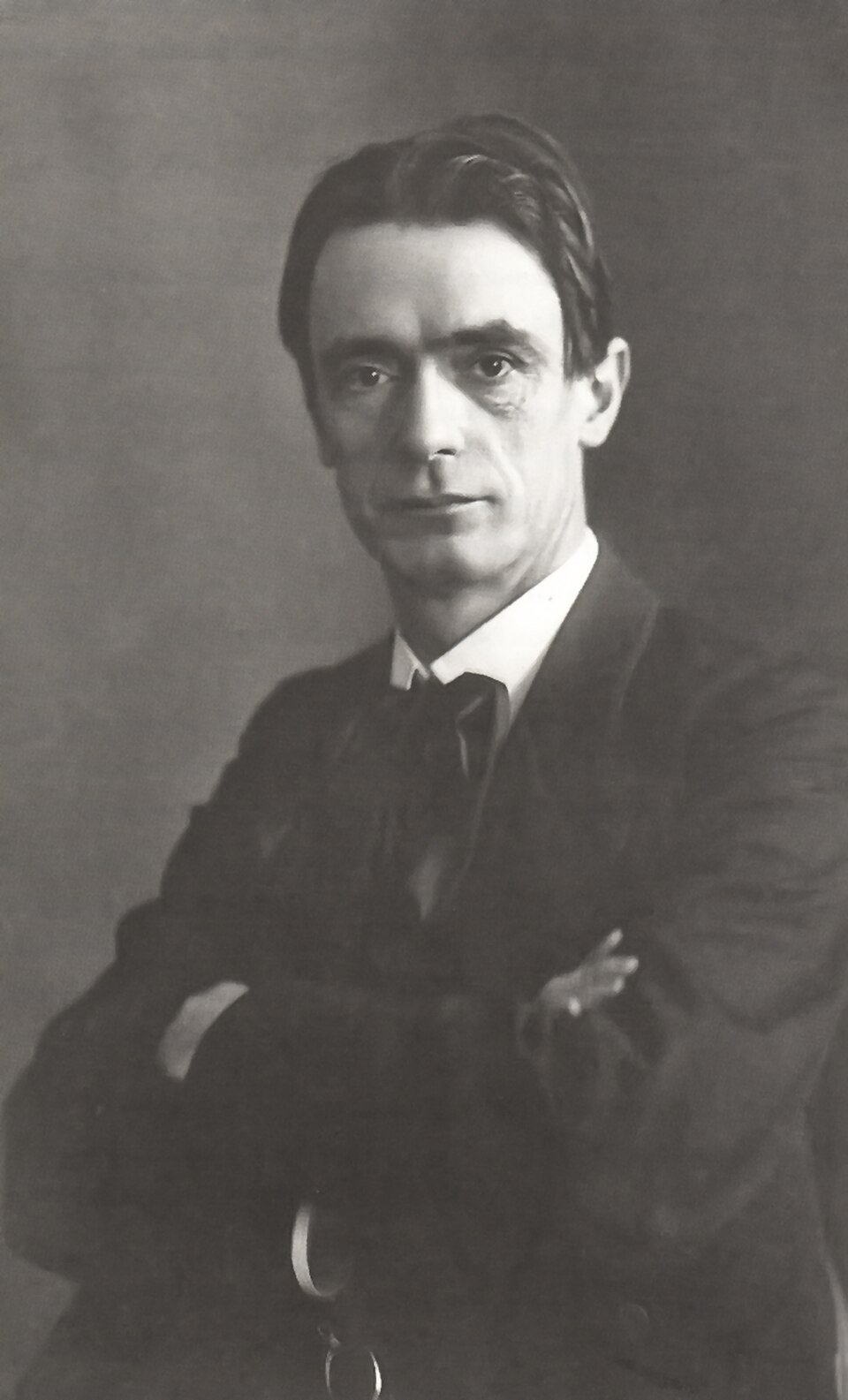
Rudolf Steiner
1861–1925 · occultist, philosopher and Austrian thinker, founder of anthroposophy
Rudolf Steiner (Donji Kraljevec, Austro-Hungarian Empire, 1861 - Dornach, Switzerland, 1925) was an Austrian occultist, philosopher, educator and social thinker who founded anthroposophy, an esoteric spiritual movement, in the early twentieth century. It drew on German idealist philosophy and theosophy. He is remembered above all in the history of ideas and esotericism. The sources consulted do not attribute any paintings to him, so his link to painting is at most indirect; his interest in the arts showed itself in drama, dance and architecture.
Steiner studied mathematics, physics and philosophy at the Vienna Institute of Technology between 1879 and 1883. In 1882 he was asked to become the natural science editor of Joseph Kürschner's new edition of Goethe, and from 1888 to 1896 he worked in the Goethe archives in Weimar. He received his doctorate from the University of Rostock in 1891 with a dissertation on Fichte's concept of the ego. His most important philosophical work, The Philosophy of Freedom (1894), was poorly received. In 1897 he moved to Berlin and edited the literary journal Magazin für Literatur, which lost readers because of his controversial positions.
Around 1902 he joined the Theosophical Society, leading its German section and, from 1904, the sections in Germany and Austria. A formal break with theosophy in 1912 or 1913 led to the founding of the Anthroposophical Society. That same year construction began on the Goetheanum in Dornach, a cultural centre designed by Steiner and partly built by volunteers. His work is often divided into three phases: an early, more philosophical one he called "spiritual science"; a second, from around 1907, of collaboration in the arts; and a third, after the First World War, of applied projects such as Waldorf education, biodynamic agriculture, anthroposophical medicine and eurythmy.
His epistemology rests on Goethe's view that thinking is an organ of perception, like the eye or the ear, which perceives ideas. A constant thread in his work is the claim that human knowledge has no limits. Many of his ideas are considered pseudoscientific, and specialists have noted influences of Christian Gnosticism on his doctrine. His legacy lives on mainly in Waldorf schools and biodynamic farming rather than in the history of painting.