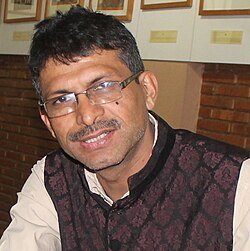
Suman Pokhrel (born 21 September 1967 in Biratnagar) is a contemporary Nepali poet, translator and artist. He writes mainly in Nepali, although he has also written in English, Hindi and Urdu, and his poetry has appeared in anthologies and journals in several countries and been translated into many languages. His standing in Nepal rests on two roles: that of an original poet and that of a translator who brings world poetry to Nepali readers.
He grew up in Biratnagar and, from the age of seven, in his ancestral village of Kachide in Dhankuta, where his paternal grandmother raised him. His grandfather, Bidhyanath Pokhrel, was both a poet and a politician, and the family library, with Nepali, Hindi and classical Sanskrit books, was his first introduction to literature. At twelve he returned to Biratnagar to live with his parents. His father, an engineer and a bibliophile with a keen interest in art and literature, played an important role in his upbringing.
Pokhrel earned degrees in Science, Business Administration and Law from Tribhuvan University. He joined the Nepali civil service as a Section Officer in 1995 and, in 1998, moved to Plan International as a development activist, a job that took him to remote hill regions. Visits to poor villages showed him at close hand the hardships faced by men, women and children, an experience that shapes much of his poetry.
His first book, Shoonya Mutuko Dhadkanbhitra, appeared in the early years of the new century, followed by Hazaar Aankhaa Yee Aankhaa Maa (2003) and Jeevanko Chheubaata (2009). Among his most discussed works is the poem The Taj Mahal and My Love, often described as innovative. He has also written song lyrics, ghazals and the play Yajnaseni, based on the Mahabharata. As a translator, he has rendered Shakespeare's The Tempest into Nepali as Aandhibehari, and poets such as Anna Akhmatova, Pablo Neruda, Sylvia Plath, Mahmoud Darwish and Faiz Ahmad Faiz.
He received the SAARC Literary Award in 2013 and again in 2015, making him the only writer to have won it twice, alongside other national and international honours. His poems are included in university syllabi in Nepal and India, and are widely shared on social media. As a painter, the available sources mention him only in general terms, without describing specific works, so his visual art cannot be assessed in detail.