
Thomas Waterman Wood
1823–1903 · American figure and portrait painter of the nineteenth century
Thomas Waterman Wood (Montpelier, Vermont, 1823 – New York City, 1903) was an American painter known for figure subjects and portraits. Working in the second half of the nineteenth century, he is best remembered for scenes that reflect the American Civil War and the move of African Americans from slavery to freedom.
He studied briefly in Boston under the portrait painter Chester Harding. Before settling in New York City in 1866, he had painted portraits in Canada, Washington, Baltimore, Nashville and Louisville. During the 1850s and after, he found the means to visit galleries in London, Paris, Rome and Florence.
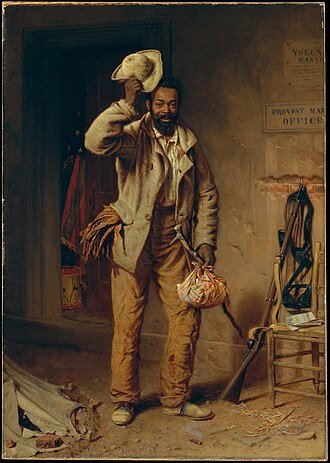
His best-known work, The Contraband, was painted while he lived in Louisville and is now held by the Metropolitan Museum of Art. He became an Associate of the National Academy of Design in 1869 and an Academician in 1871, serving as its president from 1891, and he led the American Water Color Society from 1878 to 1887.
His most visible legacy in Vermont is the Gallery of Art he gave to Montpelier, along with the many portraits of local figures held by the city's institutions.
Works (2)

The canvas shows a soldier in a genre portrait painted in 1866 by Thomas Waterman Wood, in oil on canvas. Its title refers to war, though the available information does not clarify further the scene or the identity of the sitter. It is now held by the Metropolitan Museum of Art.
Where to see the work
- Metropolitan Museum of Art New York City · 2
Teachers and pupils
Studied with
- Chester Harding 1792–1866