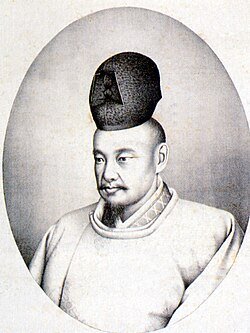
Tokugawa Nariaki
1800–1860 · daimyō of the Mito Domain and political thinker
Tokugawa Nariaki (徳川斉昭, 1800-1860) was a daimyō of the Mito Domain, in what is now Ibaraki Prefecture, and a key figure in the rise of Japanese nationalism and in the background to the Meiji Restoration. The sources consulted do not mention any painting activity, so this biography focuses on his political and intellectual role.
He was the third son of Tokugawa Harutoshi, the seventh-generation daimyō of Mito. He did not inherit the domain straight away: the headship first passed to his eldest brother, Narinobu, and came to Nariaki in 1829. He led the Jōi party, which called for expelling the barbarians, and served as a bakufu adviser on national defence. He held that the shogunate should strengthen its military and confront the foreigners, a position that put him at odds with Ii Naosuke. A supporter of the emperor, he favoured imperial restoration.
He greatly expanded the Mitogaku school founded by Tokugawa Mitsukuni and was strongly influenced by the Kokugaku school. Ōkuni Takamasa, a student of Hirata Atsutane, urged him to combine ritual with technology to protect Japan's borders and expand the country, based on reviving the Japanese "national spirit". In 1853 he wrote a document titled "Japan, Reject the Westerners", setting out ten reasons why Japan should remain isolated. He believed the Japanese should choose war rather than let Westerners intrude into their affairs.
He clashed with Naosuke over the succession to the shōgun Iesada. Nariaki backed his son Yoshinobu, while Naosuke favoured Tokugawa Yoshitomi, who ultimately prevailed. Nariaki was placed under house arrest twice, in 1844 and in 1858 during the Ansei Purge, and died of a heart attack in 1860, at the age of 60.
In 1841 he built Kairaku-en, a garden whose fame endures to this day. Three leading figures of the 1860s were his sons: Tokugawa Yoshinobu, the fifteenth and last shōgun; Tokugawa Yoshiatsu of Mito; and Ikeda Yoshinori of Inaba (Tottori). His work Kōdōkan ki was published posthumously.