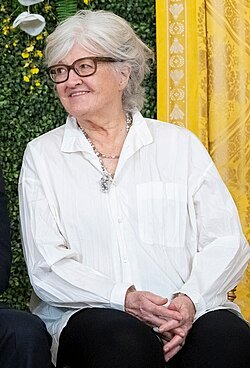
Vija Celmins
1938– · Latvian-American visual artist, photorealist painter and draughtsman
Vija Celmins (born 25 October 1938 in Riga) is a Latvian-American visual artist known for her photorealistic paintings and drawings of natural environments and phenomena: the ocean, spider webs, star fields and rocks. Based in New York City, she is considered one of the distinctive figures of late twentieth-century American photorealism, and her habit of depicting surfaces with almost no spatial reference points has made her work immediately recognisable.
Her family fled Latvia during the Second World War and, after a refugee camp in Germany, reached the United States in 1948, settling in Indianapolis. There, aged ten and not yet speaking English, Celmins turned to drawing. She studied at the John Herron Art School and in 1961 won a summer scholarship at Yale University, where she met Chuck Close and Brice Marden. That same period she began studying the work of Giorgio Morandi. She graduated from Herron in 1962 and completed her master's degree at the University of California, Los Angeles, in 1965.
In California during the 1960s she painted everyday objects and monochrome photographic images with pop references, and also works on violence and conflict such as warplanes and guns. Towards the end of that decade she largely set painting aside and devoted herself to graphite pencil, making highly detailed drawings based on photographs of the ocean, the moon, the interiors of shells and rocks. Critics often compare her meticulous approach to that of Chuck Close and Gerhard Richter, and she shares with Richter an apparent detachment in choosing her images. In 1981 she moved permanently to New York and returned to painting, while also working with woodcut and charcoal. Since then her focus has included constellations, the moon, oceans and, from around 2000, spider webs.
Her work has had more than forty solo exhibitions since 1966, with retrospectives at the Institute of Contemporary Art in Philadelphia, the Whitney Museum of American Art and the Metropolitan Museum of Art, among other institutions. Her works are held in public collections, including the Museum of Modern Art in New York. Celmins is regarded as one of the most distinctive artists of her generation for the precision of her technique and for the way her images resist any context.