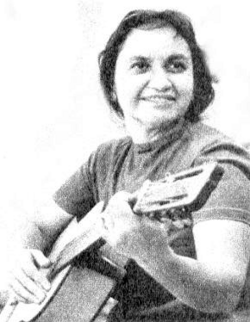
Violeta Parra
1917–1967 · Chilean singer, composer and ethnomusicologist, a central figure in Chilean folk music
Violeta del Carmen Parra Sandoval (San Carlos, 1917 - La Reina, Santiago, 1967) was a Chilean singer, composer, ethnomusicologist and visual artist, regarded as one of the leading folklorists in South America. She belonged to the well-known Parra family, and her work to recover the music of the Chilean countryside inspired many artists who came after her. Her songs have been recorded by performers from Chile and abroad, and her birthday, 4 October, is marked in Chile as the Day of Chilean Music and Musicians.
The exact date and place of her birth are disputed. The house in San Carlos was declared a historic monument in 1992 and now serves as a museum, although some people maintain that she was born in San Fabián de Alico. She was the daughter of Nicanor Parra Alarcón, a schoolteacher and musician, and Rosa Clarisa Sandoval, a peasant seamstress and singer. Her childhood was spent in the countryside and then in Chillán, where the family settled in 1927. She began playing the guitar at nine and wrote her first song for a rag doll. After her father died in 1929, she and her siblings sang in restaurants, circuses and on trains to make a living.
In 1932 she moved to Santiago at the invitation of her older brother Nicanor and began singing in bars and neighbourhood halls with her sister Hilda. In 1937 she started her professional career at the restaurant El Popular. She married Luis Cereceda, a railway worker, and they had two children, Isabel and Ángel, who also became musicians. Around 1947 she formed the duo Las Hermanas Parra, and in the early 1950s she began collecting musical traditions in Santiago's neighbourhoods and across the country. Her brother Nicanor urged her to defend authentic Chilean music against the stereotypes of the time, and her repertoire moved from boleros and corridos towards songs of the countryside. This research gathered more than three thousand songs.
In 1953 she recorded the singles "Casamiento de negros" and "Qué pena siente el alma", now among her best-known pieces. In 1954 she won the Caupolicán Prize for folklorist of the year, which led to trips to Warsaw, the Soviet Union and a period in Paris, where she recorded Guitare et chant: chants et danses du Chili (1956). Her success in Europe was unprecedented for a Chilean artist. It was in Paris that she learned of the death of her daughter Rosa Clara.