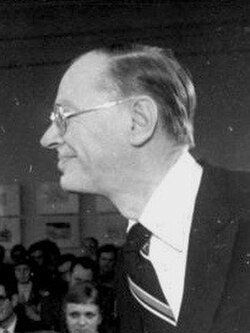
Werner Tübke
1929–2004 · German painter and graphic artist from the GDR, associated with the Leipzig School
Werner Tübke (born in Schönebeck, near Magdeburg, 1929; died in Leipzig, 2004) was one of the most prominent painters of the German Democratic Republic and a leading figure of the Leipzig School, alongside Bernhard Heisig, Wolfgang Mattheuer and Heinz Zander. He is best known for the vast Peasants' War Panorama in Bad Frankenhausen, one of the largest paintings ever made.
After studying painting in Schönebeck, he trained from 1948 to 1953 at the School of Applied Arts in Magdeburg, at the Leipzig College of Graphic Arts and Book Design, and later at the University of Greifswald, where he studied art education and psychology. From 1964 he worked as an associate professor at the Leipzig college, and from 1973 to 1976 he served as its rector. In the early 1970s he travelled to Italy, where he saw classical painting at first hand, an experience that shaped his later work. He represented the GDR at documenta 3 (1964) and documenta 6 (1977) in Kassel, and in 1984 he taught at the Salzburg Summer Academy.
His output includes several thousand drawings, more than 500 watercolours and 353 paintings, though he is remembered above all for his large-scale pictures and murals. His main genre was history painting, especially socialist history. Although he is often linked to Socialist Realism, his style moves away from that tradition toward a magic realism with surrealist currents. He regarded Lucas Cranach and Albrecht Dürer as his models, and the influence of older masters such as Hieronymus Bosch, Andrea Mantegna and Peter Paul Rubens is also visible. His figures, often dressed in an antique manner, show a mannerist distortion that led critics to describe him as a 'virtuoso neo-mannerist'.
His best-known work is the Peasants' War Panorama, also titled Early Bourgeois Revolution in Germany (1983–1989), made in Bad Frankenhausen with several assistants. It depicts a scene from the German Peasants' War of 1524 to 1525 and measures 1,722 square metres, which is why it is considered the largest oil painting in the world. Other notable works include Mahnung (Warning, 1966), tempera on canvas, and Portrait of a Sicilian Landowner with Puppets (1972), oil on canvas held in the Gemäldegalerie Neue Meister in Dresden. In 1997 he also produced an altarpiece for the church of St. Salvator in Clausthal-Zellerfeld, which brought his work to wider attention in western Germany.
Tübke's legacy lies mainly in monumental historical painting of twentieth-century Germany and in his reworking of models from the past in a contemporary visual language. The Bad Frankenhausen panorama remains his reference work and the main reason he is known beyond Germany.