
Worthington Whittredge
1820–1910 · American landscape painter of the Hudson River School
Worthington Whittredge (Ohio, 1820 - New Jersey, 1910) was an American landscape painter associated with the Hudson River School. His importance lies in combining a European training with the depiction of the American landscape, and in his friendships with key figures of the movement, such as Albert Bierstadt and Sanford Robinson Gifford.
He began as a house and sign painter in Cincinnati, later turning to portraits and photography before settling on landscape. In 1849 he travelled to Germany to study at the Düsseldorf Academy, where he befriended Bierstadt and posed for Emanuel Leutze. He then spent five years in Rome and, after returning to New York in 1859, adopted the Hudson River School manner, which brought him success. In 1862 he joined the National Academy of Design, and he served as its president from 1874 to 1875.
His most decisive experience was the 1865 and 1866 journey across the Great Plains toward the Rocky Mountains, made with Gifford and John Frederick Kensett. It produced unusually elongated, sparse panoramas, such as Crossing the Platte (1870). Other notable works include The Trout Pool (1870) and Forest Interior (1881), forest scenes in which light filters through the foliage over moss-covered rocks. He moved to Summit, New Jersey, in 1880 and kept painting into old age, though his style shifted with the changing tastes of the New York art world. His work is held by major museums, including the Metropolitan Museum of Art in New York.
Works (3)
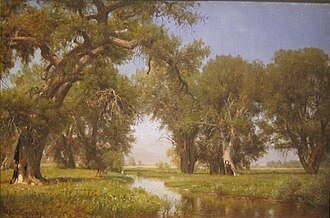

Painted by Worthington Whittredge in 1870, this oil on canvas shows a fishing pool set within a dense wood. The quiet scene invites the viewer to linger over the still water and the thick mass of foliage surrounding it. It is held today at the Metropolitan Museum of Art in New York.
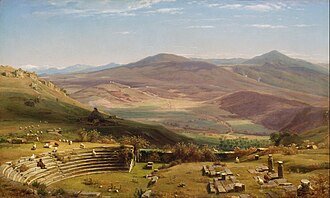
Painted in oil on canvas in 1860 by Worthington Whittredge, this landscape places the viewer before the Alban Mountains near Rome and, as its title indicates, the amphitheatre of Tusculum. Mountain is its main subject, within the landscape genre. Without further information on its commission or reception, it is best to rely on what the painting itself shows.
Where to see the work
- Fine Arts Museums of San Francisco San Francisco · 1
- Metropolitan Museum of Art New York City · 1
- Smithsonian American Art Museum Washington, D.C. · 1
Curiosities
Teenage trapper
As a teenager, Whittredge trapped animals for their pelts. By about the age of sixteen he had earned 400 dollars from selling them, and on some winter nights he walked as far as three miles to check his traps before returning to his chores on his father's farm. He recalled this effort with pride in his autobiography.
A father who scorned art
His father, a sea captain, regarded the word artist as almost an insult and considered anyone who spent his life with crayons and paints a lost soul. This disagreement, together with his own ambition, led Whittredge to leave for Cincinnati, where he lived with his sister and worked as a house painter.
Model for Washington
In Düsseldorf, Whittredge posed for Emanuel Leutze's famous painting Washington Crossing the Delaware. He served as the model both for George Washington and for a steersman in the boat. The painting is now in the Metropolitan Museum of Art in New York City.