
Yan Liben
0600–0673 · Tang dynasty Chinese painter and senior court official
Yan Liben (c. 600-673) was a Chinese painter and government dignitary active in the early Tang dynasty, who rose to some of the highest posts in the imperial administration. He was granted the title Baron Wenzhen of Boling, and his name is chiefly linked to court painting and imperial portraiture. He matters because his work shows how art for the court was made in the seventh century, when painting and public service were often practised by the same person.
His family came from Mayi, in today's Shuozhou, but had settled in the Guanzhong region around Chang'an several generations before his birth. His father, Yan Pi, served as deputy director of palace affairs under the Sui dynasty, and Yan Liben and his elder brother Yan Lide were both known for their skill in architecture in state service. Under Emperor Taizong, in 643, he was commissioned to portray the 24 most important collaborators of the reign in the Lingyan Pavilion, as well as 18 scholars who had served the emperor when he was Prince of Qin. His portraits also covered Chinese rulers from the Han dynasty down to the Sui.
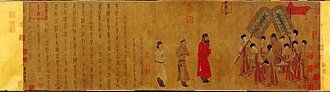
His best-known work is the Scroll of the Thirteen Emperors. He is also credited with Emperor Taizong Receiving the Tibetan Envoy, which probably dates from this period, and with Xiao Yi Obtaining the Lanting Manuscript. The Tang critics Zhu Jingxuan and Zhang Yanyuan praised his paintings as among the glories of all time. Under Gaozong, Taizong's son, he worked as imperial architect during the Xianqing era (656-661) and succeeded his brother as minister of public works. From 669 he served as chancellor, and in 670 he became head of the legislative chancellery with the title Zhongshu Ling. He died in 673.
His legacy rests mainly on the quality of his portraits, which his contemporaries ranked among the finest of their age. His career also shows that in seventh-century China painting was a prized skill, yet still secondary to a career in government.
Works (4)


The painting shows Xiao Yi and Biancai, and the manuscript of Lanting, which links them, forms the narrative core of the scene. It is attributed to Yan Liben and dated to around 700. As a landscape with figures, nature frames a specific episode rather than standing as the subject in its own right.

This work is a long horizontal scroll, its 238 centimetres of length far exceeding the 28 of its height. Its title refers to a court gathering, though the available record does not allow us to specify the scene or its setting. It is held at the National Palace Museum, where it can be viewed as an example of painting in scroll format.
Where to see the work
- The Palace Museum Beijing · 1
- Museum of Fine Arts Boston Boston · 1
- National Palace Museum Taipei · 1
Curiosities
A craft looked down upon
One day, while the emperor sailed with his scholars on the imperial pond and watched some birds, he asked Yan Liben to paint the scene. Yan, already a mid-ranking official, was embarrassed to be known only for his brush. He reportedly told his son not to learn the skill, though he kept painting out of love for it.
Mocking verses
When Yan Liben and his fellow chancellor Jiang Ke were promoted to chancellor at the same time, a set of contemptuous verses began to circulate. They said one had established his power over the desert, a reference to Jiang's military campaigns, while the other had established his fame on a canvas, a jab at Yan's painting.
Portraits of tribute bearers
The gallery linked to his name includes a Song dynasty copy of the Tang Periodic Offering Portraits, showing foreign envoys accompanied by tribute bearers. The theme reflects the Tang court's relations with neighbouring peoples and states. Since it is a later copy, it does not allow the original to be reconstructed with full precision.