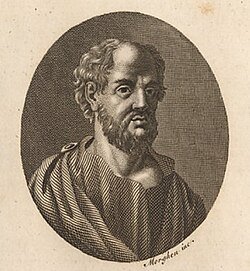
Zeuxis was a Greek painter of the Classical period, active roughly between 435 and 390 BC. He was born in Heraclea, probably the southern Italian city of that name, although this is not certain. Ancient writers regarded him as one of the greatest Greek painters of all time, and his work opened the way to trompe-l'oeil, painting designed to deceive the eye.
He spent most of his life in Athens, where he was one of the most sought-after artists of his day. He is said to have been a pupil of Apollodorus, and Pliny the Elder also names Neseas of Thasos or Demophilus of Himera as possible teachers. He competed with the Athenian painter Parrhasius. The most famous story of that rivalry tells how he painted grapes so lifelike that birds flew down to peck at them. He is also reported to have remarked that he had painted the grapes better than the boy holding them, since if he had fooled the viewers with the boy too, the bird would have been right to fear him.
He worked more on panel than on murals, and used light and shadow to create volume, depth and an illusion of space. His figures were criticised for a certain disproportion. He had little regard for public taste, which praised the originality of his subjects but overlooked fine detail. Aristotle objected that his pursuit of perfection did not capture the character of his figures, and Plato mentioned him in the dialogues Gorgias and Protagoras.
His works include a Eros crowned with roses, a Helen in the bath painted for the people of Croton, a child Heracles strangling the serpent, a Penelope said to breathe chastity, and a Zeus enthroned among the gods. For his Helen of Troy he is said to have taken the most beautiful features of five maidens of Croton. Most of his paintings ended up in Rome and Byzantium, and had vanished by the time of Pausanias. None survives.
His legacy is considerable. According to some accounts, he died laughing after painting an old woman in a grotesque manner. His trompe-l'oeil aesthetic influenced later works, such as the mosaic by Sosus of Pergamon known as the unswept floor, and probably the perspective effects found in Pompeian painting.