Winter landscapes: the most famous snow paintings
From Bruegel's Hunters in the Snow to Monet's Magpie: how winter found its way into the history of painting.
For centuries it hardly ever snowed in European painting. Landscapes were backdrops for saints and heroes, and winter appeared, if at all, in the calendar pages of books of hours. That changed in the sixteenth century, and not by chance: Europe was entering the so-called Little Ice Age, with long winters and rivers frozen for weeks. These are some of the most famous snow paintings, and what makes each of them special.

Bruegel, The Hunters in the Snow (1565)
It is probably the most famous winter landscape ever painted. Three hunters come home with their dogs, tired and almost empty-handed: all they carry is a fox. From the top of the hill we look over a whole valley, with frozen ponds where people skate, play a kind of hockey and push sledges. The picture belonged to a series of six panels on the months of the year that Bruegel painted for the banker Niclaes Jonghelinck. The Hunters in the Snow is in Vienna, and its whites, greens and blacks still look modern.
Bruegel, Winter Landscape with a Bird Trap (1565)
From the same year comes this smaller, quieter picture: skaters on a frozen river and, on the right, a trap made from a board propped on a stick, surrounded by birds. It has been read as a metaphor for the fragility of life, since the ice can break and the trap can fall. It was so popular that the Bruegel family made more than a hundred copies. You can see it in its entry.
Bruegel, The Census at Bethlehem (1566)
Another Bruegel trick: moving sacred history to a snowy Flemish village. Mary arrives on a donkey to be registered, but she is hard to spot among the neighbours slaughtering a pig, queuing at the inn or playing on the ice. This is The Census at Bethlehem, and it is worth searching for the Virgin the way you would search for Wally.
Hendrick Avercamp, the painter of ice
In the early seventeenth century the Dutch painter Hendrick Avercamp specialised in skating scenes. He was deaf and mute, and was nicknamed "the mute of Kampen", but he had a prodigious eye for detail: couples falling over, nobles in gilded sledges, fishermen cutting holes in the ice. His pictures, many of them in the Rijksmuseum in Amsterdam, are a chronicle of the Dutch winter of his time.
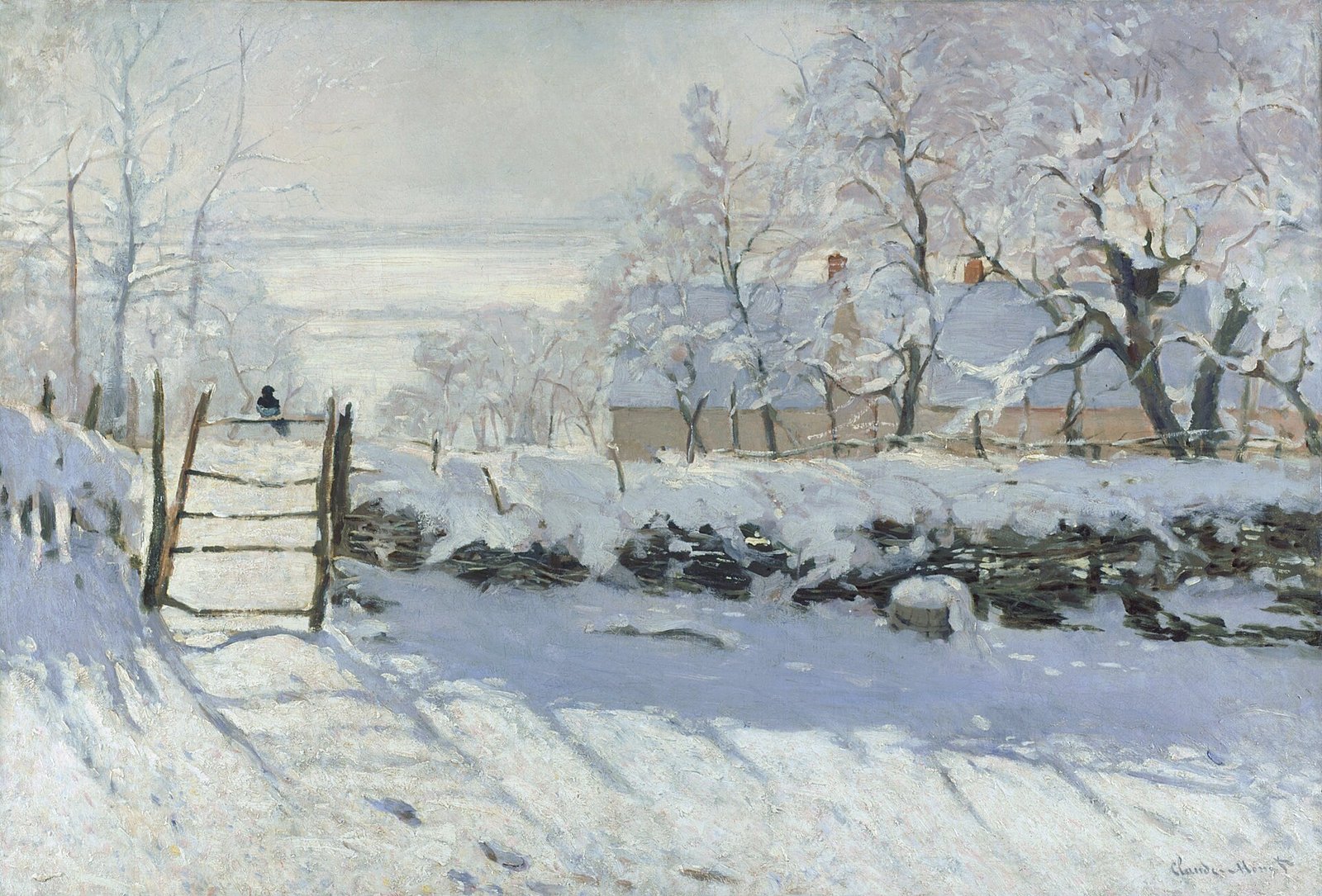
Monet, The Magpie (1868-1869)
With Impressionism, snow stopped being white. In The Magpie, Monet paints a sunny day after a snowfall in Normandy: the shadows of the fence are blue and violet, and the light has yellow tints. In the centre, perched on a gate, a black magpie is the only dark note in the picture. The Paris Salon rejected it in 1869; today it is one of the treasures of the Musée d'Orsay.
Sisley, Pissarro and the Impressionists' snow
Monet's friends also went out to paint winter. Alfred Sisley painted the snow of Louveciennes and Marly with an almost musical delicacy, and Camille Pissarro portrayed muddy lanes and frozen orchards in Pontoise. For them, painting outdoors in the middle of January was a way of proving that light changes from moment to moment.
Caspar David Friedrich: the winter of the soul
For the German Romantic Caspar David Friedrich, snow had a spiritual meaning. His winter landscapes feature ruined abbeys, leafless oaks and solitary figures, sometimes a cemetery. They are not scenes for skating, but for meditating on death and hope.
And in Spain, Goya
In 1786 Goya painted The Snowstorm, a tapestry cartoon now in the Prado: walkers push forward, bent against the wind and snow, with a dead pig slung over a mule. It is winter without decoration, far from the elegant skaters of Holland.
If you enjoyed this walk through the snow, read on with the Adoration of the Magi in eight paintings, where Bruegel makes it snow on Bethlehem once again.

