Helen of Troy
Frederick Sandys, 1867
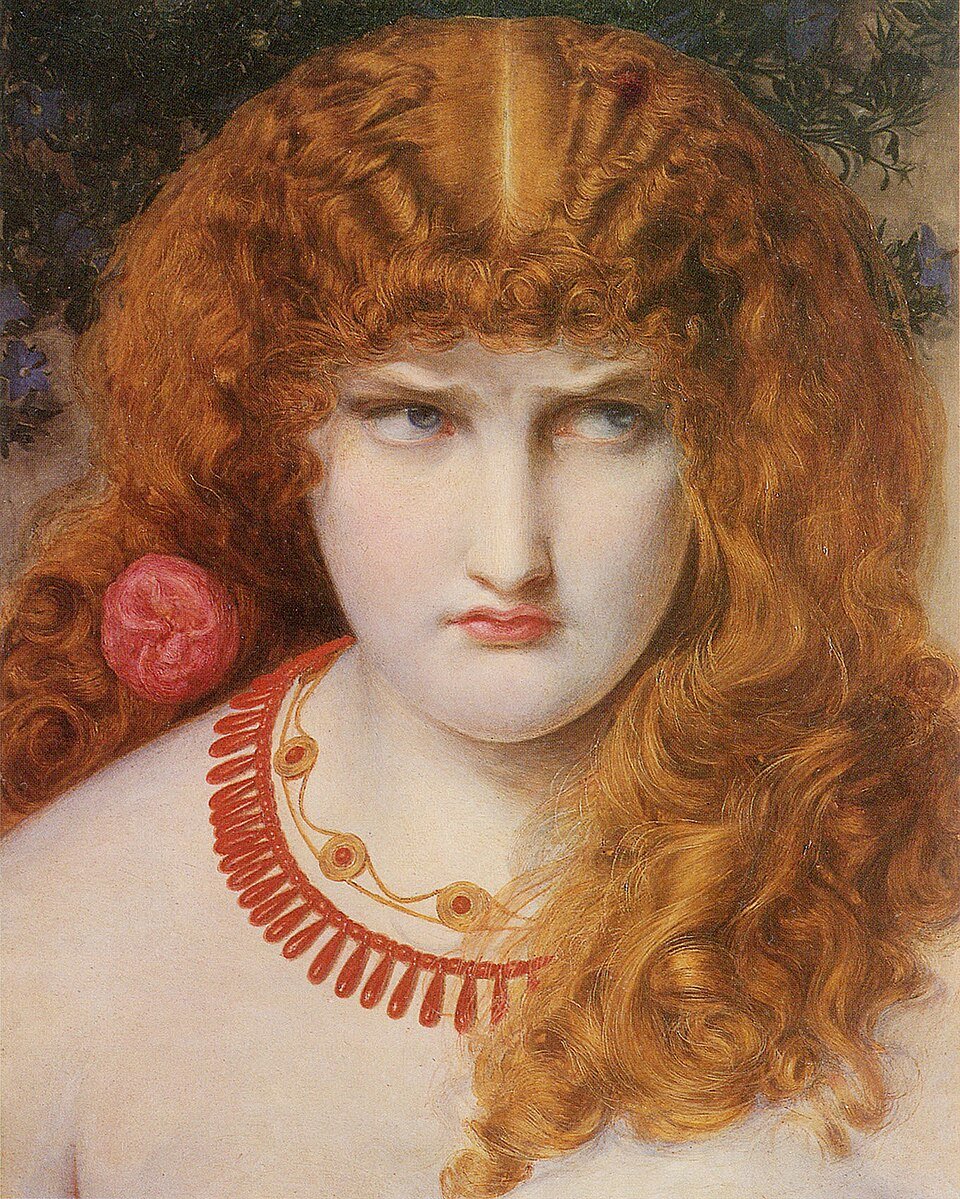
This small oil on panel by Frederick Sandys, dated 1867, presents Helen of Troy as an idealised portrait rather than a scene of action. Helen, daughter of Zeus and Leda and wife of Menelaus, appears alone and facing the viewer, with a calm and steady gaze. According to the tradition, her beauty was the cause of the conflict between Greeks and Trojans after she was carried off by Paris, son of King Priam, and the episode has recurred throughout Western art, from Jacques-Louis David to Gustave Moreau or Dante Gabriel Rossetti.
Sandys, associated with the Pre-Raphaelite Brotherhood, follows in this work his favourite features: red hair, classical features and light eyes, a canon of idealised beauty he also used in other paintings. The restrained gesture of the sitter suggests she senses the tragic fate awaiting her, and this tension between beauty and doom turns the image into a version of the femme fatale. It is a work of modest scale, whose force lies more in the delicacy of the face and the handling of colour than in any narrative.
- Painter
- Frederick Sandys
- Date
- 1867
- Medium
- oil paint, panel
- Dimensions
- 38 × 30 cm
- Museum
- Walker Art Gallery, Liverpool
- Movement
- Pre-Raphaelite Brotherhood
- Genre
- portrait, mythological painting
- Depicts
- red hair, part, Helen of Troy, blue, lipstick, necklace, eyebrow, woman