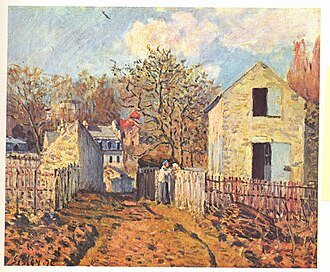
Flooding at Port-Marly
Alfred Sisley, 1876

Flooding at Port-Marly is one of four paintings Alfred Sisley produced in 1876 at Port-Marly, a village on the Seine in the countryside near Paris. The group forms part of a series devoted to a single subject: the overflowing water that submerged the riverside landscape. Sisley had already treated the same motif in 1872, when he painted a series of seven works, which suggests that flooding interested him as a recurring theme rather than as a one-off episode.
The Orsay canvas presents a seemingly simple scene: a sheet of water mirroring the sky and the nearby buildings, with a small boat that appears as part of everyday life along the bank. The reflected image on the water, where reflections soften the outlines, is one of the devices that make Sisley's Impressionist painting recognisable. He was less concerned with describing each object in detail than with recording how light changes across a moving surface.
The landscape, painted outdoors in keeping with the Impressionist practice of the group, is organised into fairly clear horizontal bands, with the sky occupying a substantial part of the canvas. The palette stays with muted, greenish tones suited to a damp atmosphere, without violent contrasts. This restraint in colour is one reason the series is regarded as representative of his approach to landscape.
The work matters because it shows Sisley's attention to atmospheric conditions and the effects of water, a subject he pursued more consistently than many of his fellow painters. Two canvases from the 1876 series are now in the Musée d'Orsay, and others are held in museums in Rouen and Madrid, making it possible to follow this motif across his career.
- Painter
- Alfred Sisley
- Date
- 1876
- Medium
- oil paint, canvas
- Dimensions
- 60 × 81 cm
- Museum
- Musée d'Orsay, Paris
- Movement
- Impressionism
- Genre
- landscape painting
- Depicts
- landscape, bark, Le Port-Marly, mirror image, sky, flood
More works by Alfred Sisley