Light and Colour (Goethe's Theory) – The Morning after the Deluge – Moses Writing the Book of Genesis
J. M. W. Turner, 1843
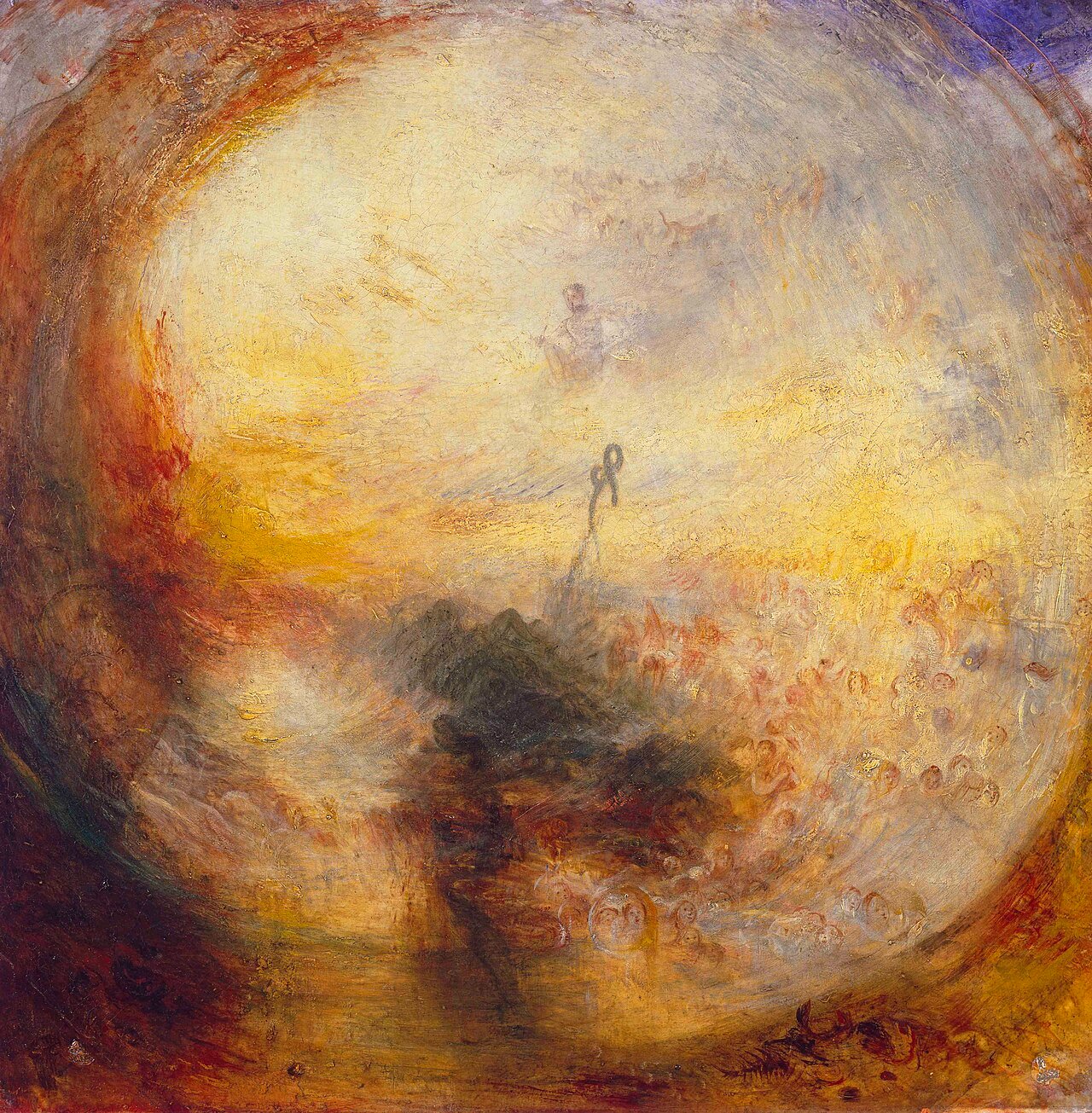
Painted in the later years of J. M. W. Turner's career and first shown at the Royal Academy in 1843, this canvas departs from a conventional narrative scene. Its title refers to the biblical flood and to Moses, yet the subject is hard to recognise. Turner does not show the flood as an event but suggests its aftermath through masses of light and colour that dissolve into one another. Nature appears both beautiful and capable of destroying and renewing life, while people are left in a passive role. For Turner, this reflects a belief in God's power, behind both the flood and the writing of Genesis.
It was paired with Shade and Darkness (The Evening of the Deluge), also shown in 1843. The two works are best read together, one as morning and the other as evening. A poem, Fallacies of Hope, is said to have been written by Turner to accompany them, although this is not fully documented.
The theoretical key is Goethe's Theory of Colours (Zur Farbenlehre, 1810). Against Newton's account, Goethe argued that colour arises from the interplay of light and darkness. Turner took up this idea in practice: yellow, linked to the strongest light, shifts toward darker tones at the edges, following the progression Goethe described toward orange and ruby red. Blue, by contrast, carries a sense of melancholy and desolation. The circular composition may be read as a reference to the human eye and departs from the linear division of space.
The painting had a turbulent history. It was stolen from a museum in Frankfurt in 1994, and in 2002 the Tate secretly bought it on the black market for about two million dollars.
- Painter
- J. M. W. Turner
- Date
- 1843
- Medium
- oil paint, canvas
- Dimensions
- 79 × 79 cm
- Museum
- Tate, London
- Movement
- abstract art, Romantic painting
- Genre
- religious art
- Depicts
- serpent
More works by J. M. W. Turner


