Sistine Madonna
Raphael, 1512
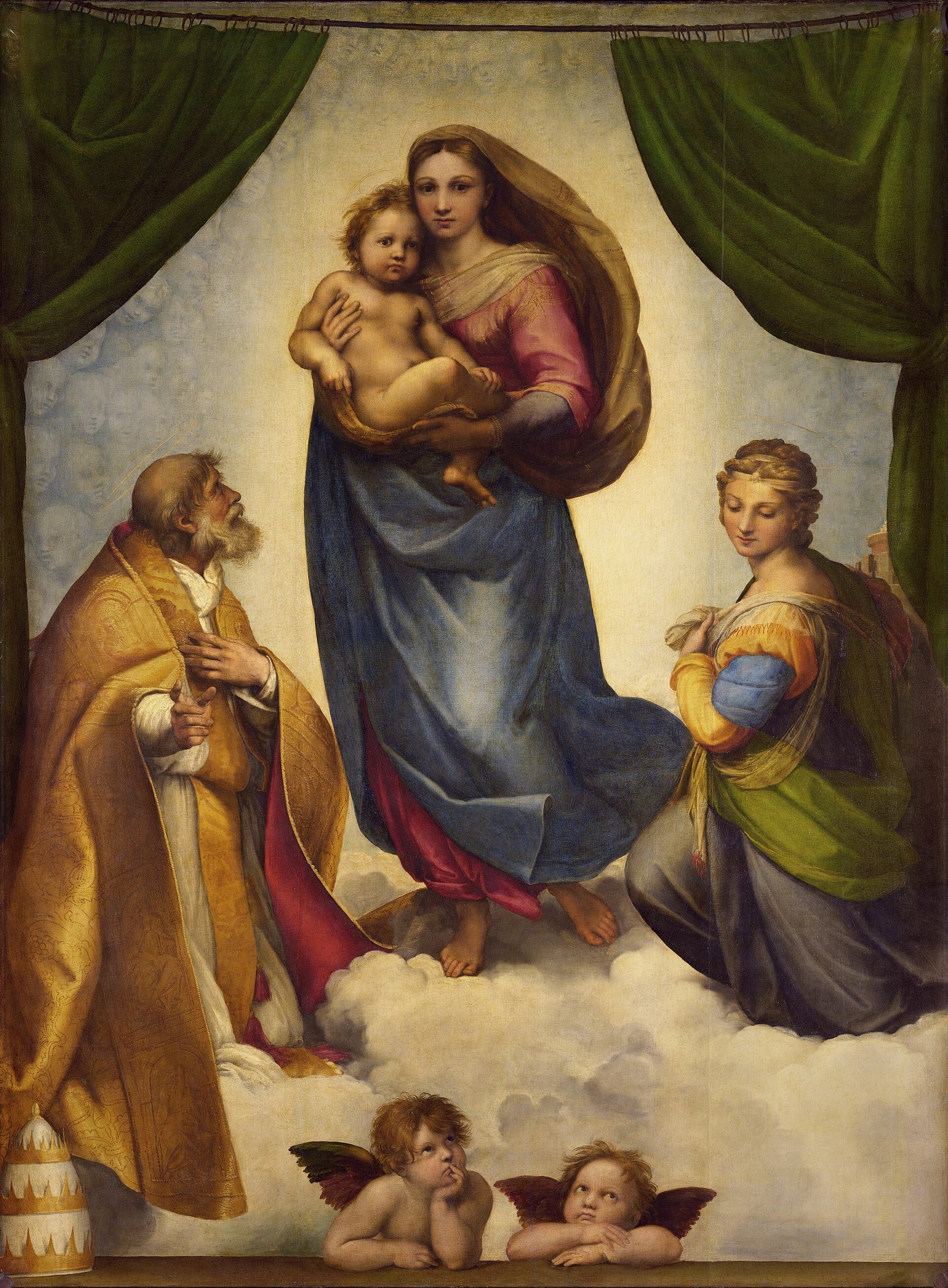
The Sistine Madonna is one of the best-known works by Raphael, the Italian painter of the High Renaissance, and the most famous of his Madonnas. It shows the Virgin Mary advancing out of a heavenly space, holding the Christ Child in her arms, accompanied by Saint Sixtus and Saint Barbara. Below the group, two small cherubs rest on a balustrade and gaze at the scene with apparent ease; over time these little angels have become among the most reproduced images in Western painting.
The composition is particularly inventive. The figures seem to stand on a bed of clouds, framed by a large parted curtain, so the Virgin appears to be descending toward the physical world where the painting hangs. The gesture of Saint Sixtus and the glance of Saint Barbara are directed at someone standing before the balustrade, probably a worshipper, and the papal tiara resting on that ledge acts as a link between the painted space and the real one. The Virgin emerges from behind the curtain with an expression that is both trusting and hesitant, and the curtain suggests at once hiding her figure and protecting the painting itself.
The work is traditionally linked to the Della Rovere family, since Saint Sixtus was the patron saint of that house, although the original destination of the painting is debated. What is documented is that it remained in the convent of San Sisto in Piacenza until 1753, when it was acquired by Augustus III of Poland, Elector of Saxony, and has since been in Dresden.
Its importance lies in the iconographic simplification of the scene: Raphael strips away incidental elements and presents the divine as it turns toward the viewer, rather than the vision of the faithful. This spiritual idealisation of the Virgin made the painting a model that was widely imitated. According to tradition, Correggio, standing before it, exclaimed that he too was a painter, an anecdote that reflects the admiration it aroused among artists of its time.
- Painter
- Raphael
- Date
- 1512
- Medium
- oil paint, canvas
- Dimensions
- 270 × 201 cm
- Museum
- Staatliche Kunstsammlungen Dresden, Dresden
- Movement
- High Renaissance
- Genre
- religious art
- Depicts
- Sixtus II, angel, boy, Mary, mother, Christ Child
More works by Raphael