Orpheus dismembered
Félix Vallotton, 1914
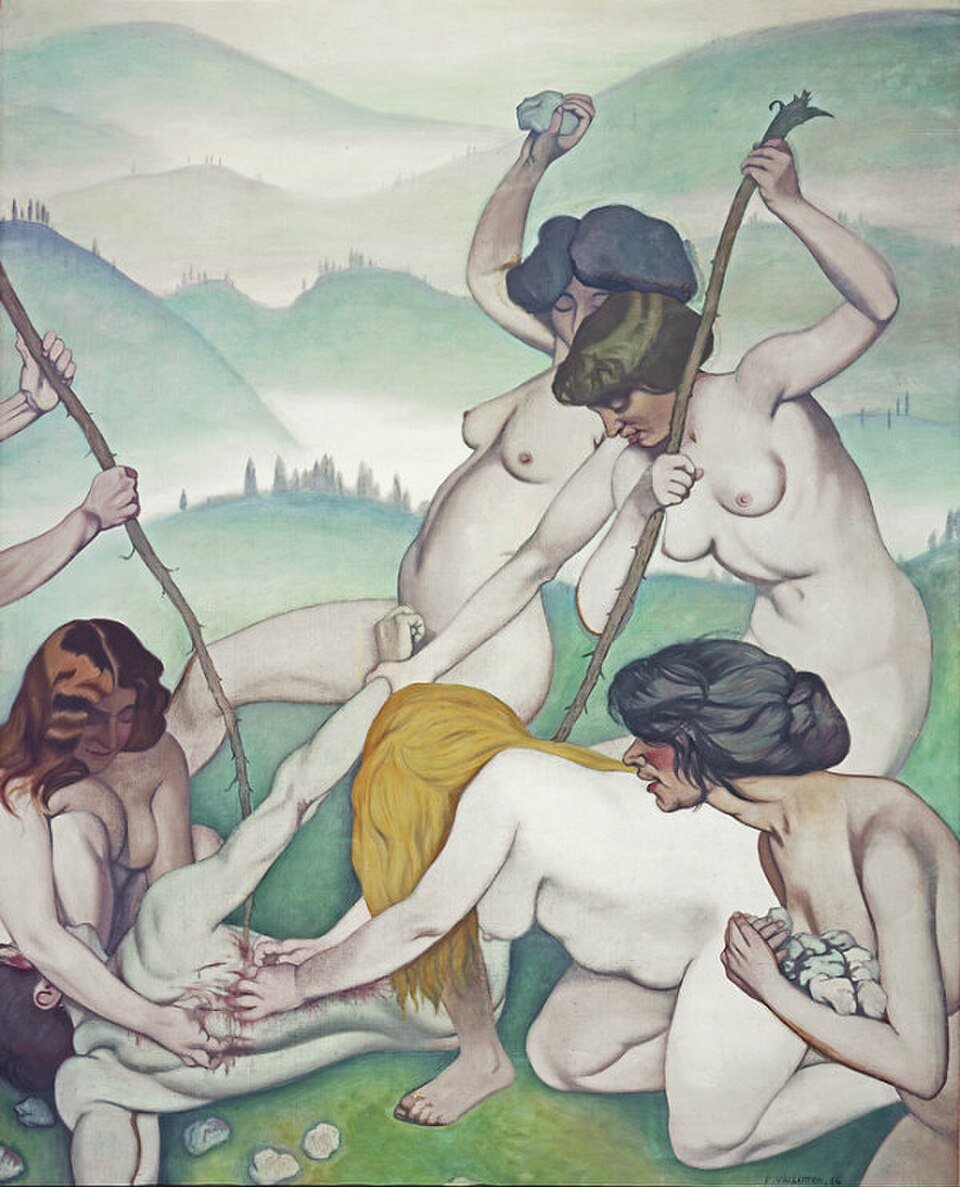
This 1914 painting by Félix Vallotton shows the final episode of the myth of Orpheus, the Greek musician and poet who, after losing Eurydice, refused the love of other women. In ancient accounts, the Maenads, followers of Dionysus, resolved to kill him through sparagmos, the tearing apart of a living body with bare hands, a practice associated with Dionysian rites. The motive for their rage varies: in Virgil it stems from Orpheus's rejection of them, while in Ovid it is attributed to his supposed love for men.
The composition places the scene in a very close view, with nude figures partly cropped by the frame. Orpheus lies face down while two crouching bacchantes dig their nails deep into his back, and other women strike him with thorny branches and stones. A mountainous rural landscape appears in the background. The Museum of Art and History in Geneva holds a pencil study of the scene that also includes the poet's lyre, which is absent from the final version.
The work is usually read as Vallotton's response to the female emancipation of his time. It belongs to a group of the painter's works with an antifeminist tone, alongside The Hatred of 1908, where the clash between the sexes was presented harshly. Here the violence becomes even more extreme.
- Painter
- Félix Vallotton
- Date
- 1914
- Medium
- oil paint, canvas
- Dimensions
- 250 × 200 cm
- Museum
- Museum of Art and History Geneva, Geneva
- Genre
- mythological painting, nude
- Depicts
- Orpheus, Maenad
More works by Félix Vallotton